>Singapore vs Indonesia

>

Because there’s no DANs in Malaysia, us parents have to look elsewhere for biomedical treatment. Singapore and Indonesia would be the closest choice. You’ll need to take into account not just the cost of consults, tests and supplements, but you should also budget for travel and accommodation costs. Some doctors prefer to see patients every month whereas other doctors are happy with every 2 or 3 months. Except for the first initial consult and when you need to do a blood draw for tests, you don’t need to bring your child every time.
For Singapore, you have a choice of flying – Jetstar is the cheapest. Driving down takes only 3 1/2 hours and you can even travel by Executive Bus. There are times when we drive down with the whole family and stay the weekend in Singapore, but there are also times when I fly down alone for a consult with Dr Erwin, pick up the supplements and catch the next flight home.
There are many hotels and service apartments at different price range. You can even stay in JB. Somerset has several serviced apartments around Singapore, our favorite is Someset Grand Cairnhill. They have very spacious 2 and 3 bedroom apartments, a nice pool and a playground area for the kids. It’s 1 minute walk to Orchard Road so it’s really convenient for food and shopping. Contact Somerset directly for the lowest rates, no minimum stay required if you book directly with them. http://www.somerset.com/singapore/singapore/somerset_grand_cairnhill.html
Dr Erwin Kay only practices from Singapore 8.30am – 1.30pm and 7.00pm – 9.00pm Tuesday and Thursday, Saturday from 8.10am – 1.30pm. He sells supplements and conducts the tests himself. He prefers to see his patients every month. He can also do Skype consults.
Dr Rina Adeline practices from Jakarta, Medan, Pekan Baru and several other locations around Indonesia. She also does online consultations with yahoo messenger. However, you will need to purchase the supplements and medications from independent shops and pharmacies in jakarta or elsewhere. And for all tests, you will need to go to the lab directly. Strictly speaking, her clinic is not in jakarta, it is a 2 hour drive (depending on traffic) in a satellite town called Bogor. You can call her clinic directly for her schedules or appointments. www.kibm.org Telephone: +62 21 84934186.
For Jakarta, KLM Airlines is the cheapest. There are also many price range of hotels, you’ll also need to hire a car and driver.
John Yeo also conducts a clinic in Johor Bahru every Wednesday. Please contact his clinic directly for details. www.autism-nutrition.com Telephone: 02-62536257
When choosing your DAN doctor, please remember that it is not going to be a one-time trip. Biomedical treatment requires many consultations, you’ll need to go back to that country or doctor to purchase the supplements. There is not a vast difference in consultation and supplements cost, however travel and accommodation costs will vary according to country.
>KL Biomed Support Group 1/8/09

>

I’m pleased to announce that there is now a support group for parents doing biomedical in Malaysia. The first KL Biomed Support Group will be held on Saturday, 1st August 2009 from 10am – 12pm.

We are a small group of parents of children diagnosed with Autism Spectrum Disorder based in Kuala Lumpur. And we are starting a support group for parents who are doing biomedical intervention for their children. The first one will be held next week, the details are as below. The primary focus of this group is to share knowledge and provide support for parents who are either already doing biomedical treatments or about to start biomedical intervention. For our first support group meet, topics will include GFCF diet, how to choose a DAN! doctor and general discussion on biomedical treatments available in Malaysia. This support group is for adults only, all opinions and advice given from this group is based on our collective personal experience and should not be construed as medical advice.

Time: 10.00am – 12.00pm
Date: Saturday, 1 August 2009
Contact person: Marissa
Email: vmarisd@gmail.com

Please email me directly if you wish to attend. I will then give you further details of the location. I hope to see you there!

>1 Year Later

>

Maya has improved considerably in the past 1 year since her diagnosis. Some skeptics choose to feel that the improvements were part and parcel of her getting older. Occasionally we feel that our efforts were being undermined by people whose lack of knowledge or ignorance makes them so quick to jump to conclusions. However, we are blessed with good friends and family who support and encourage us.
My goal is Recovery for Maya,and I look to several people for answers. Lisa Ackerman, Jenny McCarthy, Karyn Seroussi, Stan Kurtz, Dr Brian Jepson, Dr Kenneth Bock, Dr Steve Edelson, Dr Nancy O’Hara, Dr Jerry Kartzinel, Dr Elizabeth Mumper, Dr Andrew Wakefield, Dr Jon Pangborn, Dr Bernard Rimland – they may not be household names, but for us parents who chose to do biomedical, these people are our heroes. Lisa, Jenny, Karyn and Stan have recovered their kids from Autism using a combination of behavioral therapy and biomedical intervention. The doctors are all key members of Defeat Autism Now!, a fantastic foundation created by the late great Dr Bernard Rimland (www.autism.com). I have met some of the speakers and key members of DAN! and find them kind, caring, highly knowledgeable, helpful and full of integrity. So I chose to follow in their footsteps.
Autism if left untreated will either show no improvement at all or get worse. Different children will respond differently to every therapy or treatment. A combination of intensive ABA and biomedical treatment has shown the best result for us.
This is a look at Maya 1 year ago – intense echolalia, very little eye contact, prefers to be alone, lines toys up, doesn’t play appropriately, mood swings, does not handle transitions well at all. A lot of temper tantrums, banging head on the floor, crying and rolling on the floor, hyper active, wakes up in the middle of the night for 2-3 hours talking or laughing. She was constantly licking everything including toys and supermarket floors, very picky eater, addicted to milk and bread, chronic constipation, red rimmed eyes, dark circles under her eyes, tip toe walking, always climbing and jumping off furniture, runs sideways and looks out of the corner of her eyes. She was uncontrollable at times, had an intense fear of strangers, unable to form relationships with peers, indifferent to other children, does not seem to hear when we call her, when asking for something she will pull our hand and point at the thing with our hand or tantrum. We avoided taking her to public places because she would scream and scream, she was continually living in her own world. Her Psychological Assessment reports her developmental age at only 18 months, even though she was 2 years 8 months old at that time. There was very little happiness in her and we couldn’t seem to get through to her.
Maya now – she speaks in 7-8 word sentences, looks us in the eye, obeys and understands instructions, beginning to understand reasoning, she is calm and no longer agitated, no tantrums, no more rolling on the floor, sleeps 11 hours straight every night, smiles and laughs, plays well with her sister, very affectionate, greets us every time she sees us, good appetite, very easy to take out in public, shows interest in other children, has tried to initiate conversation with other kids, requests for everything with proper language, let’s us know her likes and dislikes, no more irrational fear of strangers. She now plays appropriately, has pretend conversations with her dolls and her imaginative play has finally emerged, always asking us to play with her, she is loving and responsive. We love taking Maya out, always trying to expand her horizons and giving her new experiences because she is able to absorb so much more and she genuinely enjoys new experiences. Life with Maya is now full of happiness, however there are still other issues we need to keep working on and I will keep on going until Maya is recovered.
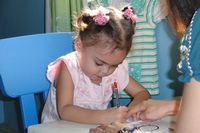
Maya is doing intensive ABA for 30 hours a week, she is doing her programs really well and her progress is good. From not being able to sit at the table, she is now learning to draw, plays games with other children, increased her vocabulary tenfold, learning more complex sentence structures, build tolerance, master many of the fine motor skills she lacked previously, able to ask and answer simple questions. ABA has helped shaped many of Maya’s abilities and intelligence that was previously shrouded by Autism.
Maya is on gluten-free and casein-free diet, low sugar, no yeast and no soy. Most of our foods are now organic, we only use organic cleaning products including laundry and dishwashing detergent, all natural and organic soaps and shampoos, we changed our Teflon cookware to stainless steel and we’ve cleaned up Maya’s room of all possible allergens.
Along with the improvements, we have experienced several set backs. Our journey has been hard, but every day we get closer and closer to the end of the tunnel.

>Scratchy Bottom & Itchy Feet

>

Maya had GI issues such as constipation, bloating, gassiness, very picky eater, a lot of pain behavior as well as yeast & fungal related behaviors. She would scratch her bottom all the time, occasionally there are peeling skin at the bottom of her feet and sometimes she would bite the skin off her toes. She hated wearing shoes and sometimes she would scratch her back till it bled.
Treating her GI issues was our most immediate concern, and we finally figured out that some of her behavior such as scratching and biting was due to yeast overgrowth.
One of the focus of biomedical intervention is to heal gastrointestinal disorders. 91% of children with Autism has gastrointestinal (GI) issues. Examples of GI distress include inflammation of the gut, abnormal intestinal permeability (also known as leaky gut syndrome), malabsorption, maldigestion, reflux esophagitis, colitis, yeast or fungal overgrowth and others. 70% of the body’s immune system lies in the gut, making it a very important part of your biomedical protocol.
Symptom –
GI symptoms usually presents itself as chronic constipation, diarrhea, abnormal stools, foul smelling stools, bloating and gassiness. Obvious symptoms such as these are easier to detect, however some children do not present these symptoms.
There are also other subtle symptoms or clues that a child has GI issues. Historical clues may include difficulty breast feeding, persistent colic, reflux, eczema, food sensitivities, picky eater, frequent antibiotics, abnormal posturing, self-injurious behavior and poor sleep. Our children may have a combination of these symptoms.
Some of the behavior linked to gastrointestinal distress include confusion, hyperactivity, short attention span, lethargy, irritability and aggression. It also causes headaches, stomachaches, constipation, gas pains, fatigue and depression. Reflux and intestinal discomfort may also be a reason for your child’s sleep problems.
You may require to do stool and urine tests for this, please refer to my previous blog on testing.
What causes it?
Gastrointestinal dysbiosis (imbalance) may occur in Autism through different means; frequent use of antibiotics causes a depletion of the good flora in our gut. The lack of beneficial flora will lead to an overgrowth of bad flora & bacteria such as clostridia. Damage caused by other environmental toxic assaults such as pesticides, heavy metals and chemicals may result in nutritional deficiencies. Food sensitivities such as gluten and casein causes damage to the intestine and the mucosal lining, which results in leaky gut and painful inflammation. Parasites and viral infections are also commonly reported in Autism children.
Yeast overgrowth
A combination of the lack of good flora and a bad diet results in yeast and fungal overgrowth. Foods such as sugar and simple carbohydrates keeps on feeding the yeast. Yeast or more commonly candida usually resides in the digestive tract. When the yeast multiples, it releases toxins in the body. And these toxins also impair the central nervous system and the immune system. Apart from rashes, yeast and fungal overgrowth may also present itself behaviorally.
Healing the gut
The basic protocol involves removing the allergens in food- the IgG food sensitivity test will help to identify what foods your child is allergic to. The GFCF diet is a very good start, also avoid yeast, sugars and artificial colors, flavorings and preservatives.
It’s important to replenish essential vitamins and minerals, give probiotics and start taking enzymes. Super Nu Thera, calcium and vitamin C is a good base to start with. Make sure you get the refrigerated type of probiotics – ask a pharmacy for probiotics multi-species at the highest CFUs you can find. I like to start at 10 billion CFUs a day, then work up to twice a day. A digestive enzyme of the DPP-IV variety is recommended with every meal. You can implement the diet, baseline supplements, probiotics and enzymes yourself.
Only take antibiotics if it’s absolutely necessary. Please make sure to replenish with more probiotics when taking antibiotics. Apart from killing the virus it’s supposed to, antibiotics also kills up to 90% of the good flora in the gut. When there’s less good flora, there’s more room for the bad flora to grow.
You will need the help of a doctor to prescribe a course of anti-fungal treatment to get rid of candida, some may need to treat clostridia, also anti-viral treatment for the viral infections and anti-inflammatory supplementation.
Healing the gut takes a long time but the benefits are enormous. Just by treating the GI alone does not mean that it will recover your child from Autism. It will take away the discomfort, allow him to concentrate and perform during therapy, it will regulate the immune system, give him a healthy body, improve his quality of life and most importantly it will take away the pain.
Nowadays, Maya is a happier girl, she has regular bowel movements, enjoys her food and is open to new textures and flavors. She is sleeping through the night, doesn’t crave for sugary treats and she no longer has dark circles under her eyes or red rimmed eyes due to food allergies. When Maya’s language improved, I asked her recently about her feet. She replied softly “It’s painful”. Now, Maya has a love for shoes and never ever scratches her bottom at all.

>A TEST of Patience

>
As Autism parents, we are subjected to numerous tests and evaluations from doctors, child psychiatrists and clinical psychologists. And these tests are just to confirm that yes, your child has Autism. What next? Therapy and more therapy.

Now that we know there are biomedical interventions that can help our children recover and we’ve done the basic steps that I’ve listed in the previous blog, and you’ve done your research, you find out there are MORE tests to be done, sigh……. So, what are these tests we need to do? Where can we do them? How much does it cost?
1. IgG Food Allergy – This is to test for delayed immune response and for food intolerances. Unlike the IgE, which is the most commonly used food allergy testing, IgE tests for immediate immune response such as common allergic reactions to peanuts and seafood. Going back to IgG, this is the test where you’ll discover intolerances to gluten & casein and others too.
In Malaysia, to do the IgG test requires drawing of blood up to 1 – 2 liters sometimes. It’s extremely traumatic for any parent and child to go through this, it took 6 people including me to hold Maya down when we did this previously. (Ironically, those tests were inconclusive and it was a complete waste of time, money and unnecessary trauma) Dr Erwin Kay has specially ordered test kits from a trusted lab (www.usbiotekcom) that only require a bloodspot – where the doctor only pricks the end of the little finger, and rubs the drops of blood onto a test pad. Maya barely even noticed it.
We did the IgG Asian Food Panel for 96 food items by US Biotek. Cost – SGD$460.00 / RM1,110.00. If you choose to do it in Malaysia, most hospitals and labs would charge RM50-70 per food item. You’d usually have to test >30 food items. A parent told me she was quoted RM300 for ONE food item! These cost do not include the consultation, lab services and other items for such procedures.
2. Comprehensive Stool Analysis – This is to test for bacteria, good and bad flora levels, fungal and yeast overgrowth, immunology, digestion, for any inflammation and fatty acids levels. You MAY be able to persuade your local doctor to do a stool test for fungal and yeast, though it would not give you a comprehensive look at your child’s digestive system and other metabolic markers. Our test from Doctor’s Data (www.doctorsdata.com). Cost – SGD$540 / RM1,300.00
3. Urine Organic Acid Test – This is to test for nutrient levels, vitamin markers, cell regulation, detoxification markers and others. We did the testing by Metametrics (www.metametrics.com) and we found Maya had amino acid insufficiencies, oxidative damage, lethargy, impaired detoxification, yeast infection and others. Cost – SGD$850.00 / RM2,060.00
4. Heavy Metals testing – you either do hair analysis or a DMSA challenge test (urine). This is to test for mercury, lead, aluminum and other toxic heavy metals. We did a hair test with Dr Sundardas in Singapore (www.naturaltherapies.com) by the lab Trace Elements, Inc. Cost – RM425.00.
Where can we do these in Malaysia? Through reports from other parents and my own experiences we find that when we go to the GP or pediatrician, (our collective experience with numerous doctors in numerous hospitals) we encounter a lot of negative responses such as `you’re over-concerned’, “these are unnecessary” or “you’re over-testing”. We parents know that our children have health issues and in order to get the appropriate treatments, we need data from these tests. I would recommend to go directly to a DAN! doctor either in Singapore or Indonesia. Otherwise, expect a battle of words with your doctor and expect to go home totally infuriated & frustrated.
While waiting to see a pediatrician recently, I noticed that it takes less than 10 minutes for a doctor to diagnose a patient and send them home with antibiotics, whilst it took Paul and I a full 1 hour to beg, plead and convince the doctor to do these tests. The `wait and see’ approach should not be applied to any child who’s suffering from chronic constipation, diarrhea, chronically ill from fever, colds and flu, or exhibiting self-injurious behaviour such as head banging, because we the parents know that our kids are in pain, all the time.
These are the basic tests that you usually do, depending on your budget, talk to the doctor whether you can do this all at once or if you wish to stagger it. You may have to do more testings, but that would probably come at least 1 year later, after you’ve addressed all the issues found from the first tests. Good luck & share your experiences with me and others. There’s a lot of rainbows in the sky, if only we keep looking for it.