>Piano recitals and Bicycle Rides

>

A couple of months ago, Maya started to play the piano. Paul had taught her to play Twinkle Twinkle Little Star and she caught on very quickly. Based on those basic notes, she then taught herself how to play other songs. She doesn’t play one-fingered, instead she has good fingering technique. She taught herself to play Farmer in the Dell, Baa Baa Black Sheep, Mary Had A Little Lamb and other songs. She would play and sing along, even in different keys and even uses the minor keys.

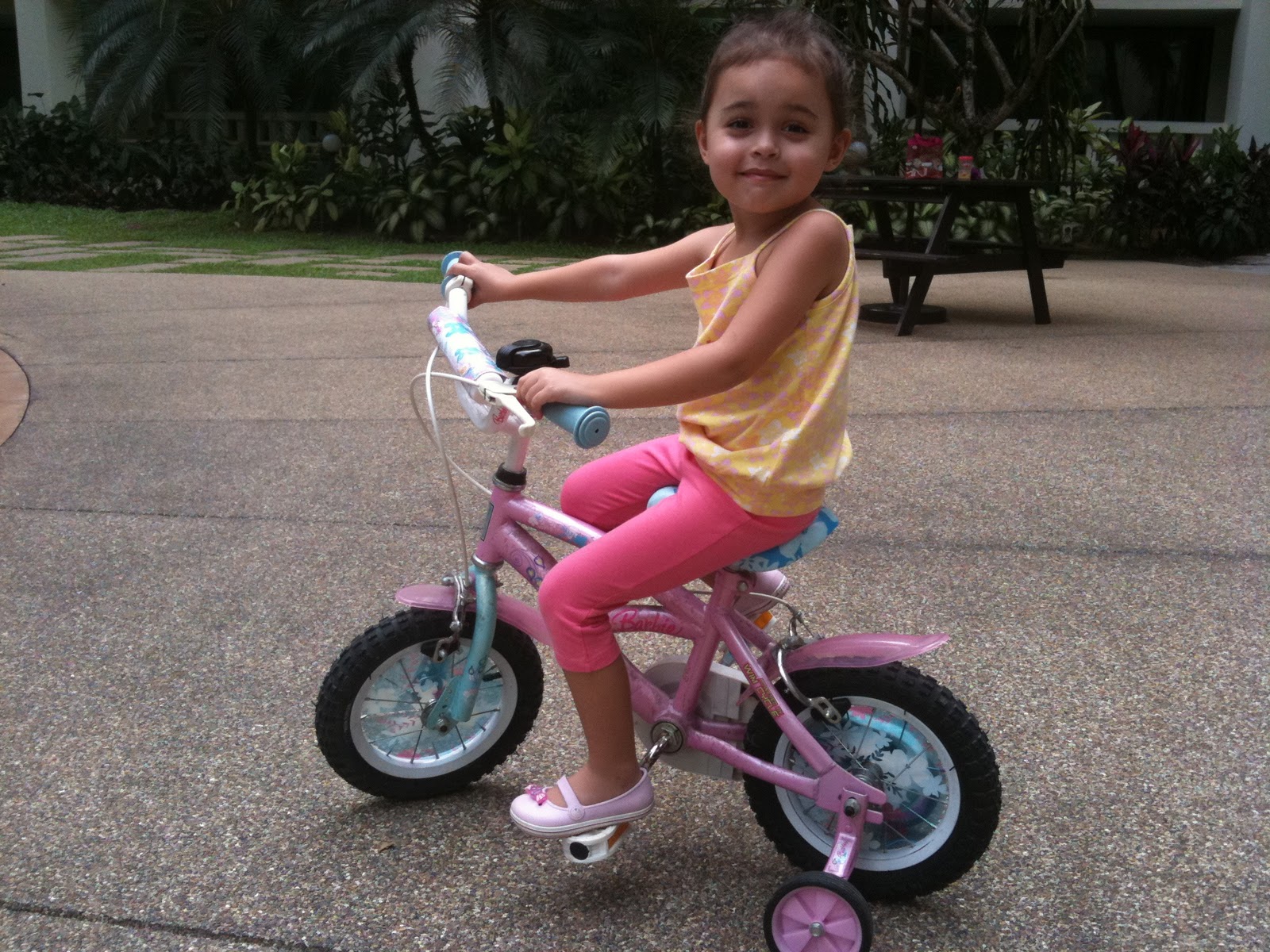
That same week, she also started riding her bicycle. We had bought her a bike a year ago as her 4th birthday present. Though genuinely excited, she could never figure out how to pedal. We got tired of pushing her on the bike and she soon lost interest. We weren’t sure whether she had such low muscle tone that she didn’t have the strength to push the pedal hard enough, or whether she wasn’t able to coordinate her limbs and senses to pedal or she was simply too young to ride. However, we knew many children younger than her who were able to pedal and ride a bike. After some time, the bike was kept forgotten collecting dust. Until she suddenly expressed an interest in the bike again. We dusted off the bike, Maya hopped on and started pedaling like she’s been doing it all her life.

Initially, we thought that it was a coincidence. That she was finally at the appropriate age to learn these new skills and physiologically old enough to master these skills. After all, I myself learnt to play the piano when I was 4 years old. But I had formal piano lessons then, whereas Maya did not. And it wasn’t as if we had been teaching Maya to pedal, we had forgotten we even had the bike.

That week was also coincidentally our first round of DMSA chelation. Yes, it was ironic that we started chelation AFTER Maya officially recovered from Autism. Throughout her biomedical journey, we had to prioritize her treatments based on her most pressing issues. So, finally we got to the point when we were ready for chelation. We had been doing the prep work prior to chelation the 2 months before, prepping her body by adjusting her mineral levels, testing for her current Red Blood Cells Minerals levels, testing for her kidney and liver function, Urine Prophyrins test for heavy metals body burden levels, then doing the pre and post challenge test to make sure that the dosage was right and that we got a good excretion rate. Once the results were back, everything looked good and our doctor gave us the green light for our first round of DMSA.

We saw the doctor a couple of weeks after we completed the first round of DMSA and he asked whether we saw any improvements in Maya. Paul and I explained that it was hard to tell if there was any because Maya was just remarkable all the time, every single day. We said that either there were either no improvements from it or any gains that were made was too small to notice. But we did mention about Maya’s piano playing and bike riding which occurred within the first few days of the DMSA round. Our doctor immediately said that it’s probably the chelation which has brought on this new burst of coordination in her gross and fine motor skills. But Paul and I said that it was just a coincidence.

We put his remarks aside, thinking that he was just searching for improvements when there was none to be had. After all, most parents only report improvements from chelation after several rounds, usually after 12 rounds. This was only our 1st round.

However, a conversation with a friend later that week changed my mind. I casually mentioned that we had just done our first round of DMSA. He had started chelation for his son a few weeks earlier. And I laughingly told him about how the doctor was pressing me for some sort of positive response to the chelation, even though it was too soon to tell. His next words stopped me cold- he said that his son started to ride the bicycle right after his first round of DMSA. He said that something just ‘clicked’ in his son and his coordination finally kicked in. Apparently, he had been trying to teach his son to ride the bicycle for ages before that, but he just couldn’t seem to grasp how to pedal. He is convinced that chelation was the catalyst.

I then told him about Maya’s piano playing and riding the bicycle. So, even after all these years, it was nice to be reminded again of how Biomed is helping us realize Maya’s full potential. Sorry we doubted you Doc.

We had only done 2 rounds when Maya experienced fierce Candida flare-up. As you know, yeast tends to flare-up during chelation. Maya started to exhibit Candida symptoms again and as she was due to start in a new kindergarten so we chose to postpone chelation for a while. We wanted to deal with the yeast first so that Maya could start school at her best. We have dealt with yeast many times, so yet another flare up doesn’t bring about the same anxiety and stress as it used to. A round of natural antifungals did the trick and we are now on to our 3rd round. We started chelation quite late by most standards, our methods still are slow and steady. But it has served us well.

Yesterday, I heard Maya singing a new song, it sounded very much like the first refrain from Rihanna and T.I.’s song Live Your Life. Maya was going “Maaa ya Hii, Maa ya ho, maaya hii, maaa ya ha aa”. I asked her what song she was singing and where she heard it. She said “I heard it on the radio” I have never played any of Rihanna’s music with Maya before, so I knew she didn’t pick it up from home. Then I asked her where did she hear the radio, she replied “At baby Rekha’s house”. Now I remember, we went to a birthday party at Rekha’s house 4 weeks back. They played pass the parcel and they played pop songs for it. And yes, Rihanna was playing that night. It was a fun and noisy party that went on until quite late. The music was blaring, there were many children and adults, lots of activity and mayhem. A year ago, we couldn’t even contemplate going to the party, the sensorial overload would have been too much for Maya to bear. Not only did she fully participate in all the games, she had lots of fun and didn’t even require Mum to accompany her. How far we have come.

Not only was I continuously amazed at Maya’s memory, she also has perfect pitch. Maya has never sang that song before to our knowledge since the party, neither has she heard it since. However only the night before she had her first DMSA dose for the 3rd round of chelation. She’s had her 2nd dose last night, let’s see what other nice surprises Maya has in store for us today. Am I grasping at coincidences? Maybe. But I am seeing wonderful improvements every day. We are looking forward to more piano recitals, impromptu arias and bicycle rides……
>Heart Full of Courage…..

>

Due to several reasons, we chose to move Maya to yet another kindergarten, her 3rd mainstream Kindy so far. This time around, we decided not to have a shadow aide to assist her in the first few weeks of the new school. More importantly, we chose not to inform the school of Maya’s history and diagnosis. We did not want the new school to have any preconceptions of Maya and we wanted to see if Maya could fully integrate into the new school without any special help. We were warned that moving Maya so soon to a 3rd school and without any shadow aide was a terrible idea. Against all professional opinions, we chose to do it our way, as usual. 
The last few weeks in her previous school, I had told Maya that soon she’ll be going to another new school for big girls. Soon she’ll be saying goodbye to her current school and she’ll make some new friends at the new school. Kids being kids, she took it all in stride. Yes, she understood what I told her. I had driven past the new school a couple of times to show her the new school. We had a little farewell party at her previous school on the last day of school. She said goodbye to all her teachers and friends and everyone gave her a big hug. It was hard to say goodbye yet again, however we felt that this was for the best. 
Both girls are now in the same school, finally. It was a relief to drop them off and pick them up from the same school, no more driving to 2 different locations everyday. Both girls now are on the same school holiday schedules, we used to have 1 girl in school and the other girl at home for holidays. We couldn’t go on family holidays as both schools were on differing schedules. It was easier for us logistically as well as in other ways. 
We brought Maya and Yasmin in for the first day of the school term in early September. There were scores of other students starting their 1st day in school too and other new parents. We introduced them to the principle and their own homeroom teachers. Then both the girls went to their respective classrooms with their teachers. Maya is in the older class with other 5-6 year olds and Yasmin in the 3-4 year old class. Paul and I hung around for the next half hour to observe both girls. By then, both girls were fully settled in their class and participating in the day’s activities. I said goodbye to Maya and told her that we’ll be back to pick her up at the end of the school day. She said bye and turned her attention back to her task. Paul and I stayed nearby the school, in case we got an emergency call from the principle. We were anxious and worried, after all, we just left our 4.5 year old and 3.5 year old daughters in a brand new school after only 30 minutes.  I worried that Maya would be anxious in the new environment, new teachers, new classmates and strange schedule. As usual, Maya surpassed our expectations.
When we came to pick them up, Maya and Yasmin were both smiling and beaming. Both girls told us of the happy things they did that day, Maya more eloquently than Yasmin. From the 2nd day onwards, we dropped them off at the school gate and we didn’t need to stay.
A few weeks before starting her new school, Maya was experiencing slight regression due to Candida overgrowth. She was a bit unfocused, her eye contact deteriorated and at times her echolalia would return. She also tended to talk on and on, not noticing that her classmates were no longer paying attention, she would go off on a tangent and ramble off the topic. We put her on a course of anti-fungals and hoped that it would be resolved before she started her new school. I wanted her to be at her best in the hopes that it made it easier for her to navigate the new social challenges that a new school demanded. 
I also told Maya that when she’s in class, we should be quiet. We should not talk unless the teacher talks to us first. We should pay attention in class and do our work. I wasn’t sure whether she understood the lesson I was trying to teach her, but I hoped some of it would sink in. 2 weeks ago, Paul and I requested a meeting with the girls’ teachers. The school explained that it wasn’t time yet for the usual progress review, but we insisted. They very kindly accommodated us. We sat down with the principle and Maya’s homeroom teacher, they explained that she is a bit quiet in class, she has made friends with all the girls and she already has a best friend. They also remarked that she is very eloquent. The teacher noticed that Maya has very firm likes and dislikes when it comes to food during lunchtime, refusing soft, mushy porridge and doesn’t want to eat fruits. I explained that Maya has always been a picky eater and requested that they continue to encourage her to expand her food choices. However, most lunchtimes, she happily sits with her classmates at the table and eat the same foods served in school.
The teacher also said that Maya needed to be reminded to finish her worksheet, not to hand it over before it’s completed. We asked if other children were able to complete their worksheet without prompting, and the teacher and principle assured us that all the other students were the same as Maya. All the kids needed to be prompted to do their work correctly and to complete the task. Phew, I was worried there for a moment. Maya’s favourite subjects are Music class and gym. She loves doing science experiments and her Mandarin articulation is excellent. Maya joins in every activity and completes every task required. Her handwriting isn’t great but her reading is above her age level. Overall, the teacher is very pleased with Maya and didn’t have any issues to bring to our attention except for her refusal to eat porridge and fruits.
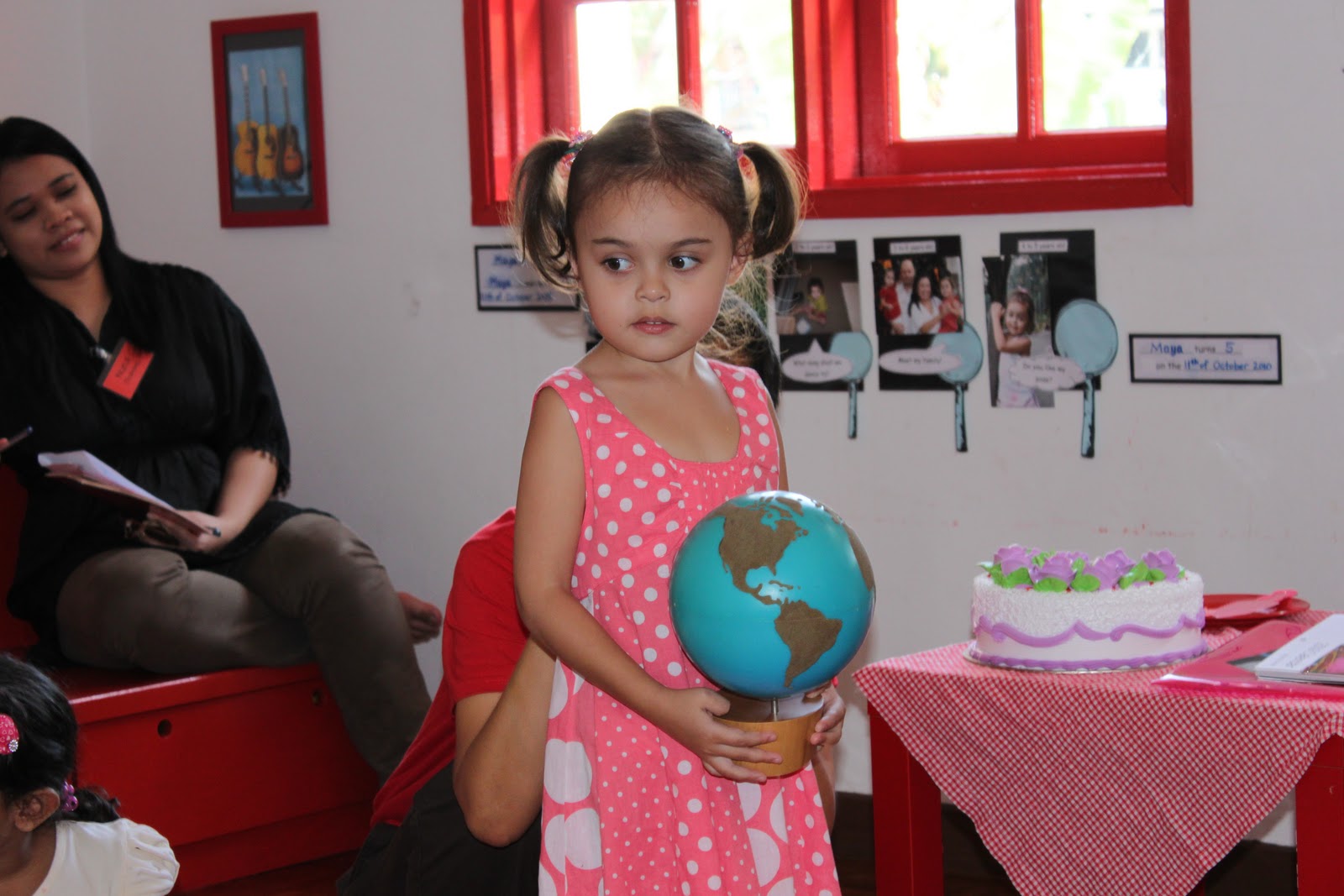
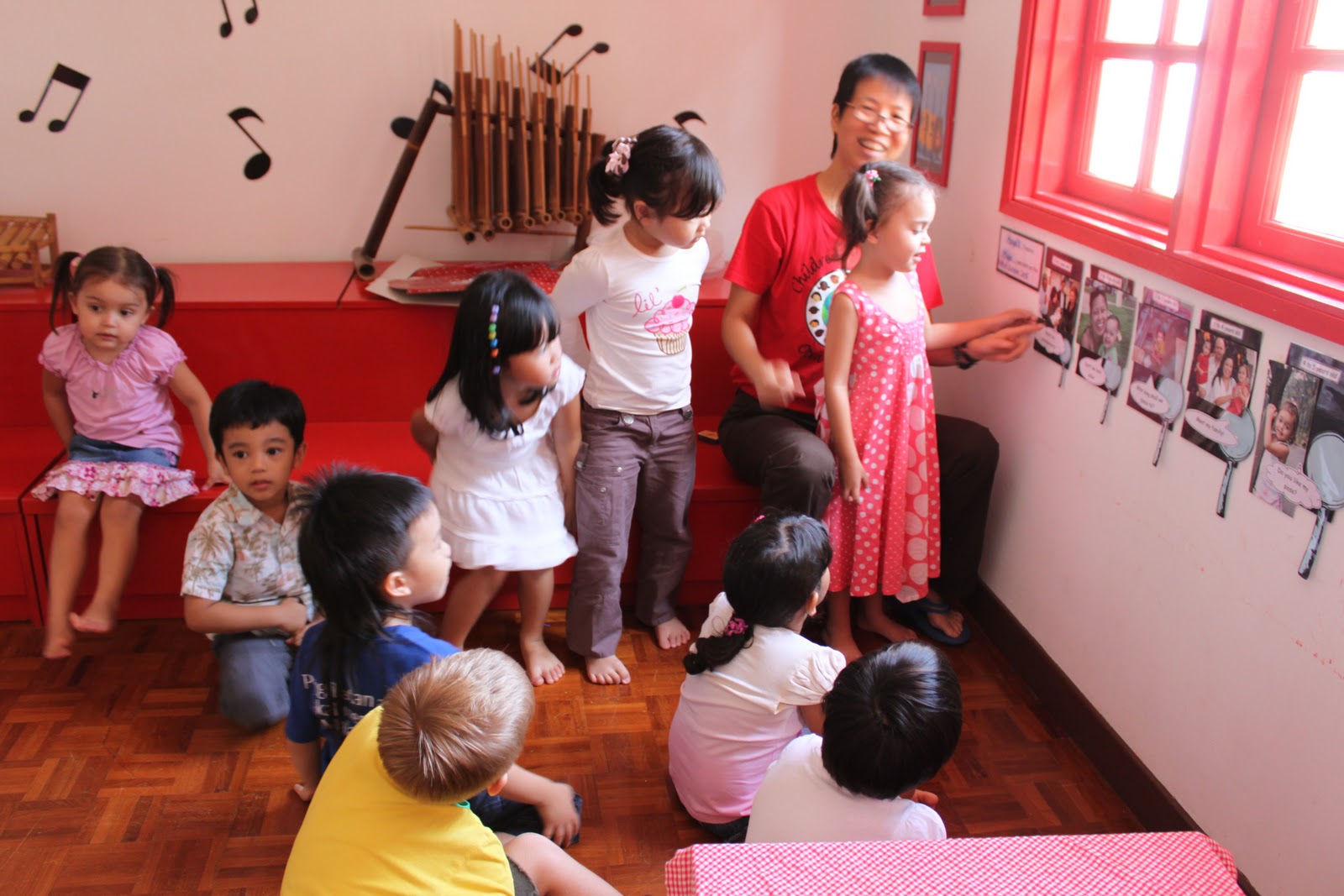
Maya turned 5 years old last week. So we had a little birthday celebration for Maya in school. The school has a birthday ritual called the Birthday Walk. The birthday girl walks around the globe the number of times as her age. The parent will show some photos and tell her classmates of her life. I had brought in a birthday cake and the teachers helped to put up some photos to show her class.  Maya was very proud to hold the globe and walk around. She blew out the candles and cut her cake. She also told her classmates and teachers about each and every photo. She is a great little speaker, her teachers told me later on how great her speech was. Her classmates were very nice kids, Maya was part of a clique of girls and played well with each other. It was heartening to see how well Maya was doing. 
I noticed several other kids in Maya and Yasmin’s class who still needed either their mum or nanny to be present in school and kids who would cry for their parents after being dropped off. I thought that I would have to be at the school for at least a few more weeks before Maya was comfortable being on her own. I expected the teacher and principle to talk to us of any p
roblems with Maya. She seems to be just like any other student there. 
We were told that we were pushing her too hard, that Maya was not ready for another new school, that she was not ready to be in school without a shadow aide, that Maya will experience terrible regression, anxiety and failures. As usual, they underestimate just how high Maya can soar.  My daughter is brave and intelligent, her heart is full of courage.  She bravely takes up every new challenge and obstacles in her path, she conquered Autism. She continues to conquer every social challenge and sensorial assault till this day.  Her strength and resilience is humbling. She makes me proud of her every single day. 

10 Valuable Lessons For Autism Parents: A Journey Of Grace And Dignity

Featured

I am a mother of 2 children who are now recovered from autism. In my journey of healing and recovering them, I learnt that anything is possible. As a mother and autism advocate, I share with you some valuable lessons I learnt in my journey.

When both my daughters were diagnosed with autism, in the midst of my grief, I had to pick myself up and figure out a way to help my children. What do I do, where do I go, how do I start? For families who have just received the autism diagnosis, believe in HOPE. Without hope, you have already lost the fight before you’ve even begun. Always believe that our children can improve and even recover.

autism

1. Attitude is everything

How you respond to something will determine your outcome. If you choose to walk down this path full of fear, anger, hate, scepticism, negativity, sorrow, or jealousy, expect to receive the same in return.

The first few months after my daughter received the autism diagnosis, I lived in a life ruled by fear. Fear of the future, fear of the unknown, fear of taking risks, fear of making the wrong decisions, fear of whether I can do what it takes to help my child. A life led by fear is not healthy. It also stops you from moving forward.  It was a lonely, scary journey.

I realised that this is not helping my child at all. The fear is still there, it will never go away I think. However, the difference is, I no longer let the fear stop me from doing what is best for my child.

You’ve probably heard of the law of attraction. The philosophy of ‘like attracts like’ is extremely powerful. If you have a lousy attitude, chances are, no one is clamouring to help you and your child. More often than not, you will meet resistance and hostility.

Reset your attitude, you will be surprised to how much more you will receive in return. There is an infinite amount of love, hope and positivity in the universe. You just have to reset your frequency to tune in to that positive abundance.

2. Fill your space with positivity

Surround yourself with positive, supportive and encouraging people. These are the ones who will stay with you along the way and cheer you on. Don’t waste your precious time and energy on negative people who will only hold you back and make you feel worthless. They will drag you down instead of helping you up.

To the ones who make you angry or say hurtful things, just smile and walk away. Don’t scream at others. Screaming doesn’t help the situation, it only makes things worse. If you have done wrong, apologise.

Fighting only zaps your energy. Don’t fight in front of your children, they can hear you and remember what you said. Autistic children are not deaf. Don’t forget to hug and kiss your child. Even if you think they’re not listening, always tell them how proud you are of them. Love them and kiss them everyday, this is better than any therapy or medication. Don’t forget to surround your child’s space with positivity too. They need it.

Always treat your therapists, service providers and medical professionals with respect. They are there to help your child. Always pay them on time. Consistently paying them late is a sign of disrespect and lack of character on your part. Being rude or mean to them is just cultivating negative emotions. Surely you don’t want your child to be treated or taught by people full of anger and resentment right?

Choose hope and positivity. Expect this to be a journey full of challenges and pitfalls. But also expect pleasant surprises and wonderful progress. Autism never stops, it never takes a day off, it never gives us a break. Our children live in autism 24 hours a day. Always treat our children with kindness and respect, we can only guess how it feels to live in their bodies.

Trust me, it’s easier and happier to travel this journey when you fill your inner space with positivity and surround yourself with the right people.


3. You are what you eat!

Clean up your child’s diet immediately and focus on healthy, nutrient-dense foods. My daughter responded positively to the GFCF diet. Within the first week of the diet, she spoke her first word!

I went gluten-free, casein-free, soy-free and egg-free. Omit all gluten (wheat, oats, rye, barley) and casein (cow and goat milk-based products, milk, yoghurt, cheese, butter) I stopped soy too because soy’s biochemical properties are very similar to casein, plus majority of autism kids test very high intolerance to soy. Most ASD kids also have very high intolerance, if not allergies, to eggs.

Incorporate nutrient dense foods in your family’s diet. Go organic and GMO-free if possible. Choose grass-fed, free-range, antibiotic-free meats. Very important to reduce or stop processed, packaged foods and drinks that contains preservatives, colorings, flavorings, artificial sweetener, caffeine. Stay away from sugar and high fructose corn syrup. These really affect our kids and behavior!

Do the diet 100%. Yes, there are other kids eating junk food and bread in front of your child. Your child WILL try to eat forbidden foods. Yes, other family members don’t want to follow the diet. Yes, grandparents will smuggle a bit of ice cream in. There will be transgressions, it happens. Start the diet again. Find a way to make it work. Eventually, the diet becomes 2nd nature.

4. Autism is medical

Many children with autism suffer from gastrointestinal issues, oxidative stress, nutritional deficiencies, immune dysregulation, inflammation, allergies, chronic infections, and disorders resulting from environmental toxins.

Treat the underlying medical illness, a healthy body means a healthy mind. If your child has chronic constipation, diarrhea, unable to eat, frequent infections and illness, do not make autism an excuse not to treat your child. Not everything in autism is behavioral, some are medical conditions that needs medical treatment. Every child deserves good health, autism or not. Everyone deserves good health and medical treatment during illness, whether they are young or old.

Make an appointment with a biomedical doctor. They will help you address the underlying medical issues that are common in our children. Click here for Biomed Doctors. There are other treatments that are highly beneficial for children with autism and ADHD, including homeopathy, osteopathy, cranial sacral therapy, essential oils, to name a few. Please consult with a medical doctor or a healthcare professional to manage your child’s treatment.

5. Finding the right therapy and school

There are many types of therapies that are beneficial for our kids. In my opinion, any therapy you choose should be intensive, consistent, preferably 1 on 1 therapy. For many children who are new to diagnosis, larger student to teacher ratio may not be suitable initially. It is important to invest in a good quality therapy or therapies that are consistent, frequent and conducted by trained professionals. Choose therapies that are targeted at addressing your child’s needs. The therapy should adapt to suit your child, not the other way round.

Remember, early intervention is key! I did 1:1 ABA therapy (Applied Behavior Analysis) for my daughter, and I can’t recommend it enough. When she was first diagnosed, I did home based ABA, 15 hours of therapy a week. By the time she was 3 years old, I changed to centre-based ABA, with 30 hours a week of therapy. That made a HUGE difference in her progress. There are pros for home-based as well as centre-based therapy. Ultimately, I chose centre-based therapy as there were many more benefits compared to home-based therapy for my daughter.

Doing home-based therapy was fine for a while, but after some time, I found many aspects of her development were not addressed enough if I kept her home all the time. Centre-based therapy helped with social-skills, generalisation, flexibility and also is a gentle transition to a mainstream school environment. Also, on the plus side, she had access to many more variety of toys, reinforcers and games at the school. And there were lots of therapists and other children there to play with.

I am the co-founder of Brightstars, it is a holistic school for children with autism, ADHD and learning challenges. I set up the school with my 2 good friends who are also mothers of children with autism. We have always dreamt of a school that had all the best therapies and programs that we felt were most beneficial to special-needs school. We dreamt of a school that focuses on quality rather than quantity. A school with a 1 to 1 student to therapist ratio. A school filled with the best, brightest and most compassionate therapists ever. A school that was sensory-friendly, quiet and calm. Most kids with autism find noisy and busy schools a sensory nightmare. So we put great thought in the design of the school. I wanted a school that was comfortable, friendly and fun. Most importantly, I wanted a school where each child can reach their fullest potential.

Brightstars incorporates a comprehensive curriculum with a 1 to 1 student to therapist ratio. Each child receives an individual education plan (IEP), ABA therapy, occupational therapy, sensory integration therapy, music therapy, Autism Movement Therapy, social skills playgroup, school readiness program, and more! To find out more about Brightstars – Life Skills For Exceptional Kids click here www.brightstars.my 

6. Get connected

Get connected, get educated, start surfing – join the KL Biomed FB Group to connect with other parents who are doing nutritional approach, biomedical treatments and various therapies.  Don’t forget to check out The Thinking Moms’ Revolution and connect with them on Facebook. Get acquainted with other parents, they will be your main source of support on this often long and lonely journey.

Remember, you are not alone.

7. Take care of yourself

Take care of your physical, mental and emotional health. Don’t be afraid to ask for help. Don’t forget to eat well, get enough sleep, exercise and eat healthy. By taking care of my health, I was more equipped to handle the stress and rigours of special-needs parenting. I could do more for my child when I myself was healthy.

Don’t forget to nourish your soul- go for a massage, go to a salon for a hair wash, go for a swim, go to the cinema, walk in the park, have an afternoon nap or  go for a coffee with a friend. Try to do something just for yourself once a week. Without you, you child will not improve.

I take supplements, eat healthy, try to exercise and I make personal time for myself regularly. I feel all the better to face the challenges that autism throws at me everyday. Not everyone will have the resources to afford this, not everyone is blessed with helpful family members or friends who can share the burden and give us the break we need. As far as autism parents go, I am extremely lucky indeed and I count my blessings. Manage your resources wisely, however little we may have.

It is hard to strive for recovery when the mum is in deep depression and under extreme stress, the goalpost seems further away when we feel bleak, dejected and pessimistic.

If you are married, take care of your relationship. You are not the only one grieving, your spouse is too. Along the way, you will lose your sense of humour. Try to regain that, you will need it. Have patience. Learn to forgive.

Don’t forget to pray. Only pray for good things. Worrying is praying for bad things. So, pray for good things. Set realistic goals. Give yourself small challenges. Don’t sweat the small stuff, look at the big picture. Celebrate the victories, small or big. Mourn the losses, but pick yourself up and keep going to the next level.

8. Focus on what you CAN do, not what you CAN’T do

I always tell parents to focus on what they can do. Don’t focus on the things that you cannot do. Focusing on the things that you don’t have, can’t do, can’t afford etc, is a waste of time and energy. Instead, put your energy into the positive actions that you can do TODAY.


9. Set realistic expectations

Be realistic in your expectations. There is no miracle cure, no magic pill, no one size fits all when it comes to autism. It takes hard work, perseverance and TIME for our kids to improve. Expecting a child with 3 years worth of speech delays, behavioural issues and sensory disorders to improve drastically within just 6 months of therapy and treatment is unrealistic. You cannot catch up with years of delays in just a few short months. Anyone who promises you miracles cures or instant results, be wary.

Think big, aim high. Don’t underestimate your special child, you might just be pleasantly surprised. Don’t let anybody hold you or your child back.

10. Forgive yourself

It is not your fault. Your child’s autism was not caused by bad parenting. Blaming yourself only brings you down. Ultimately, you need to move on. Don’t waste your time on guilt, it is counter-productive. It’s not helping your child.

Remember to go through this journey with grace and dignity. Our children are voiceless, it is up to us to speak up for them. Don’t forget why we do this, out of love for our children. A smile goes a long way, a thank you even longer. Don’t forget those who have helped you along the way, pay it forward in the hopes that you too can help the next new parent that comes your way.

~ Marissa aka Spectrum Mum


Autism, Glutathione and Star Wars…


star-wars-yoda-movieStar Wars – a sci-fi movie series with a cult fan following. Darth Vader, Jedi Knights, Yoda, Luke Skywalker and Princess Leia are the central characters.

Autism – the fastest growing developmental disorder in the world. 1 in 45 children are diagnosed with autism. A person with autism face challenges in speech and communication, behavioural issues and socialisation. Many people with autism also present many health challenges such as food sensitivities, digestive issues, impaired detoxification, nutritional deficiencies and more.

Glutathione – pronounced “glue-te-thai-on”. A powerful antioxidant.

So what does autism, glutathione and Star Wars have to do with each other you ask?
In her book Healing Our Autistic Children – A Medical Plan for Restoring your Child’s Health, Dr Julie Buckley calls most antioxidants the Jedi Knights in the metabolic sense. However, she calls glutathione Yoda. As many Star Wars fans know, Yoda is the legendary Grand Master of the Jedi Order and can do many wondrous things.  My Star Wars fan hubby was duly impressed with the analogy. As he would put it, glutathione is Yoda whilst MB12 is Obi-Wan Kenobi. To date, we haven’t decided what Luke Skywalker is…….

By now, most of us have read and heard about the importance of glutathione. Glutathione levels is something that most biomedical doctors are concerned about. Glutathione (GSH) is a powerful antioxidant, it is the key detoxificator in our body.  It plays a fundamental role in numerous biochemical and metabolic functions. Most chapters in biomedical books or topics in biomed conference stresses the importance of glutathione. Children with autism either have too little of it or the subset of kids who do have adequate levels of glutathione are not utilizing it into the proper detox pathway, instead it goes on to be utilized for other functions. Some children also have adequate levels of GSH, but their toxin load is so high that it’s just not enough. Most children on the autism spectrum need glutathione support, either by supplementing it directly or by enabling the body to produce more. Oxidative stress, damage from heavy metals, immunological and metabolic disorders are common culprits of lowered glutathione production and depletion. Glutathione is a topic close to our hearts namely due to the heavy metal and environmental toxin load that is commonly found in our kids and the high need for an efficient detox and methylation pathway.

According to her OATS (Organic Acid Test), my eldest daughter Mei had impaired detox markers and low levels of glutathione. Our second round of OATs done a year later showed marked improvement overall. This also commensurate with better cognitive function, enhanced skill sets, reduced behavioral challenges, improved fine and gross motor skill, age appropriate language skills and immense reduction in Autistic traits overall.

We raised Mei’s glutathione levels directly by transdermal lotions as well as supplementing with N-Acetyl Cysteine (NAC). NAC is the precursor to glutathione, it is commonly prescribed by biomed doctors. A small subset of children don’t do well on NAC as it does have a tendency to increase yeast. In some children, it tends to raise their sulfur levels. For us, we did not experience any obvious side effect from NAC. Even though it is known to cause yeast flare-ups, it wasn’t a big deal for us because we were constantly battling yeast anyway, so what’s a little bit more yeast right? Our biomed doctor put both my girls, Mei and Min Min on NAC almost immediately, we used it for 1.5 years. We no longer use it now as Mei’s glutathione levels are fine.

Supplementing Glutathione
Depending on your child’s unique health issues, there are several methods of supplementing GSH- oral, transdermal, suppository and intravenous;

1. Oral glutathione supplement is used widely, however it may affect the gut and cause yeast overgrowth. It is also not as well absorbed compared to other types of supplementing GSH. All of my biomed doctors did not recommend oral GSH for both my daughters due to their own unique issues.

2. Transdermal ie. creams are quite popular because it is easy to administer and relatively affordable.  Glutathione lotions are easily available from many supplement providers. I have tried over the counter as well as specially compounded, personally I don’t see any obvious difference, but I do like trying different brands and rotate. For my 2nd daughter Min MIn, her American biomed doctor ordered a compounded glutathione lotion from a well-respected speciality compounding pharmacy. The compounded glutathione came in a double vial, with an activator as well as the glutathione. Many believe that the activator enables better absorption. It is slightly more expensive, you do need ask your doctor to order it specially for you.

3. Suppository- this is a popular choice amongst some biomed doctors in Asia. It is more readily absorbed and comes in higher dosages. These need to be prescribed and specially ordered compounding pharmacies. These can be quite expensive, they have a short shelf life, dosage is according to body weight and frequency is usually once a week. Some children do well with glutathione suppositories and some do not. We were quite excited to try this out, unfortunately Mei had a negative reaction almost immediately after administering it. Within 1 hour, her temperature shot up to 40 degrees Celcius. I believe it was just too much for her. Lesson learnt. I don’t think it is possible to predict which child will react well to them, we can only try and observe. Some children who are doing chelation (heavy metal detox) also use specially compounded DMSA suppository combined with glutathione.  It is interesting to note that glutathione suppositories are not popular in most countries. 

4. Intravenous (IV) glutathione is a popular choice in certain countries such as the USA. At some clinics, patients can receive intraveneous glutathione infusions. This provides the best absorption, however the potency or effectiveness is for a shorter period I believe.

Glutathione Inducers
I spoke to the legendary Dr Sidney Baker about other forms of glutathione supplementation. I explained that IV glutathione is not available in many parts of Asia. I asked which was better, transdermal or suppository? Dr Baker replied that in his opinion, he much preferred inducers of glutathione rather than supplementing it. He highly recommended N-Acetyl Cystein. He also mentioned that several foods also helps with glutathione production.  Broccoli sprout extract, turmeric, curcumin (an extract of turmeric), Vitamin D, dark chocolates, most foods with strong or interesting taste are said to be glutathione inducers.
One biomed doctor gave me a quick tip to determine whether we had adequate glutathione levels- if your urine does not smell strongly after eating asparagus, this may be a sign that you do not have adequate levels of glutathione. Thus, if you eat asparagus and afterwards your urine stinks, then your liver and detox system is probably fine. However, this is not a definitive test, merely a simplistic DIY self-evaluation. Some people can still have adequate levels of glutathione yet are not utilising it metabolically.


What To Expect
When we supplement with glutathione, it works on a more cellular level. Increasing the body’s glutathione levels either by supplementing it directly or by inducing better production by NAC or food inducers will improve the detox function. However we do not expect to see any behavioral improvements or reduction in autistic traits. The basic principle is that more glutathione is needed to detox effectively, a better detox function enables the body to flush our toxins, a body with less toxic burden is healthier, a healthy body equals healthy mind.
Glutathione is not an autism treatment per se, ultimately it seeks to lower the toxic levels in our bodies, thus enabling better health for our children. It is important to remember how crucial glutathione production is in our biomedical treatment protocol. Treating oxidative stress, lowering the toxic burden and improving the nutritional status also helps towards glutathione production.
What Affects Glutathione Levels?
Panadol (paracetamol) or commonly known as Tylenol in the USA, decreases glutathione levels markedly. Judicious use of Tylenol should be observed, however we need to keep in mind how it affects glutathione. On occasions when you do need to use Tylenol, it is best to remember to keep glutathione levels up. On the other hand, ibuprofen is another popular choice for fever or pain management. Ibuprofen does not decrease glutathione levels. However, with any pharmaceutical drug, there are also other issues to consider when deciding which medication to use.
My children and I have not used any fever medications for several years now. I prefer to support the body during times of illness with homeopathic remedies, essential oils, healing foods, herbal and natural remedies.
Many babies and young children are advised to give Tylenol before or after a vaccination shot. Being the concerned parents that we are, we wanted to save our kids the pain of the injection. Unfortunately, now we know that by giving Tylenol, the glutathione levels drop drastically, right smack during the time when our babies need them the most. By reducing the glutathione levels, our kids are left with very little detox support. Right when they are hit with the multiple viruses and heavy metal load.
Many children receive vaccinations as well as Tylenol almost simultaneously, and yet never end up with autism or other vaccine-induced injuries or disorders. However, these are the genetically and physically lucky ones who have better metabolic, mitochondrial and detox function and is able to take the multiple hits that vaccinations give. There are many causes for autism. Vaccinations, viruses, Lyme disease, environmental toxins and pollutants, pesticides, GMOs, genetics, food allergies, GI disorders, mitochondrial and metabolic disorders to name a few. For my children, glutathione support is important metabolically and played a part in their recovery from autism.


We only tried the glutathione suppository once, Mei did not react well to it, so I continued with the lotion. I used glutathione lotion on Mei and Min Min every night for 1.5 years, the girls love their nightly massages before bedtime. They were calmer due to the gentle, soothing strokes and we make it a special moment between mother and daughter.


Keep the glutathione levels up guys! We all need a little bit of Yoda in our lives. We’ll be eating asparagus, broccoli sprouts and turmeric for dinner with dark chocolates for dessert tonight followed by the Star Wars movie marathon:-) May the Force be with you……


About Spectrum Mum in Malaysia – Marissa is a mother of 2 children who are recovered from autism. She is the co-founder of Brightstars – Life Skills for Exceptional Kids, a holistic school for children with autism, ADHD and learning challenges in Kuala Lumpur. Marissa is the co-author of Autism Beyond The Spectrum and Vice-President of The Thinking Moms’ Revolution, an autism advocacy movement based in the USA. In 2009, she founded KL Biomed, a support network for parents with children affected by autism and related disorders in Malaysia and neighbouring countries in Asia. Marissa is a blogger, autism advocate,  passionate about nutrition and natural health. Her blog Spectrum Mum In Malaysia is inspired by her children’s journey and experience in recovering from autism. She lives in Kuala Lumpur, Malaysia.

>Nordic Naturals in Malaysia

>

Nordic Naturals is now available in Malaysia. It is sold at Bebehaus stores in Bangsar Village 1, Mont Kiara and 1 Utama. They also accept online orders and can ship within Malaysia and internationally. Please contact them directly for the types of Nordic Natural’s range of fish oil and flavors they carry at www.bebehaus.com The product is not listed in their website but it is definitely available in their stores. They carry limited stock so please call them directly beforehand.

Nordic Naturals fish oil is certified pure and mercury-free. At the DAN conference in April 2010, many parents questioned about whether they were soy-free. We were assured by DAN speakers on stage (I think it was Dr Sid Baker or Dr Jon Pangborn) that it is GFCF and soy free compliant as the soy derived ingredients does not actually include soy proteins. 
Fish oil and cod liver oil contains Omega 3, an Essential Fatty Acid that contains DHA and EPA. The benefits to supplementing with EFAs are enormous, not just for children with Autism but for everyone too. Our bodies do not produce EFAs, it is  obtained from food sources such as fish. For most people, we benefit in a diet high in fatty fish, olive oil and eggs as they provide high amounts of EFAs. However in Autism, our children have problems converting the EFAs from food into the form that is necessary for many biochemical reactions. Unfortunately, certain fatty fish are also known to contain high amounts of organic mercury. And many children on the Autism spectrum also have allergy or intolerance to eggs. Thus, the need for a pure, mercury-free source of fish oil is very important. 
Fish oil is one of the first supplements to start on in biomedical treatment, nearly all ASD children will benefit from high doses of Omega 3. Take note that Omega 6 and 9 should be taken in moderation if at all, the balance ratio of Omega 6 to Omega 3 should be closely monitored. Most children only need Omega 3. There are many certified mercury-free fish oils such as Kirkman’s, ProThera (parent company of Klaire Labs), EyeQ and Nordic Naturals to name a few. You can also buy them online from the online shops listed on this site. However, for Malaysian parents who are not able to purchase them online from overseas stores, please contact Bebehaus to enquire about Nordic Naturals. 
Personally, we have used Efalex (a locally available fish oil, though not certified mercury-free), Kirkman’s Cod Liver Oil, several different formulations of Nordic Naturals and Eicosamax Omega 3 from ProThera. We have also used Evening Primrose Oil instead of fish oil for a brief period as it has a calming effect. Currently, my girls prefer the taste of Eicosamax Liquid by ProThera. Fish oils are available in liquid, gel capsules and chewables in many flavors. Depending on your child’s age and ability to swallow, there are many choices out there for every one. Some children show almost immediate improvement on Omega 3 supplements, however some don’t. Both my girls do not seem to show any obvious improvements however this is an important supplement in our biomedical treatment and we give them fish oil every day. We also believe that EFAs were crucial in reducing the girls’ inflammation and oxidative stress.
My husband and I also  take fish oil capsules daily to improve our health and mental abilities. I don’t think it has made us any smarter, but we do feel better knowing that we are doing all we can to keep depression at bay and to prevent Alzheimer’s. Another plus is that my skin and hair are not as dry as it used to be. No more patchy dry skin and frizzy hair!
Please read this inspiring article on fish oil and Autism, hopefully you too will experience the same in your child. http://healthfreedoms.org/2010/02/02/how-fish-oil-unlocked-my-autistic-son/


>Post Endoscopy & Colonoscopy…….

>

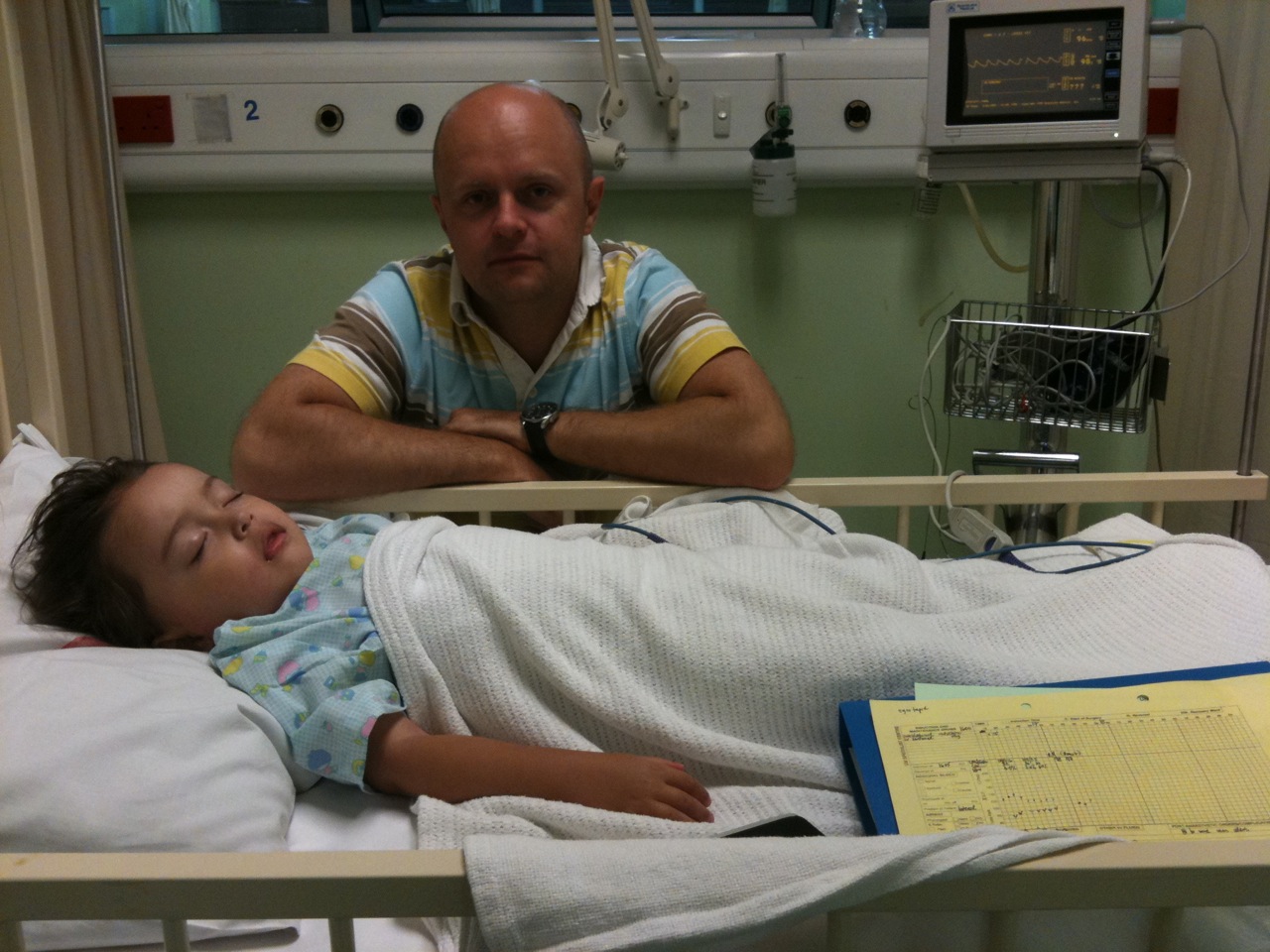
Yasmin got through the endoscopy and colonoscopy safely. Our thanks for all the well-wishes from many good friends, it gave us strength. Though she was admitted on a Thursday, the scope was scheduled on Friday. When it was time, I carried Yasmin down to the OR, dressed in her little surgical gown. The anesthetist placed the gas mask over her face, she struggled a little but quickly succumbed. Paul and I waited outside for a while and later the doctor invited us in to take a look at the monitor. It was hard to tear my eyes away from Yasmin lying unconscious on the table, meanwhile the doctor showed us several parts of her large intestine.

He did not use a pill-cam even though we requested for it. According to other pediatric GI specialists in the UK and USA, they commonly use pill-cams for young patients even 3 year olds. However, I guess things are different here in Malaysia. Due to the traditional cam scope, the doctor is not able to check the small intestines. However, he did a thorough check on the entrance into the small intestines. The endoscopy was then over, and it was time for the colonoscopy. We then waited outside again, and were invited back into the OR once the doctor had gone into the colon. He showed us her colon and as before, he kindly explained where and what we were seeing and findings he had.

Overall, the up close and personal look at Yasmin’s inside was a revelation. She was absolutely perfect! Everything was pink and healthy as it should be. There were no signs of inflammation, lesions, polyps or anything else out of the ordinary. Paul and I are immensely relieved that she did not have any of the GI diseases we initially suspected. It was good to know that she is not in the kind of awful pain that was reported in many children in GI literature.

Once the procedure was over, I carried Yasmin to the recovery room. Once her condition was deemed stable, we brought her up to her room. It took a long time for her to wake up from the general anesthesia, nearly 2 hours. Even then, we tried several methods to wake her up. We were warned that some patients when coming out of GA tend to act aggressively, cry or act weird. We were prepared for that, but Yasmin was totally fine apart from being groggy, sleepy and a bit uncoordinated, as was expected. The doctor discharged us soon after and Yasmin was happy to be home though tired. We were relieved to be home on Friday night, I was not looking forward to another night in hospital. Caring for a child in hospital is hard enough, even though it was only for 2 days. However, this was during Ramadhan, it was harder to go through it physically, mentally and emotionally while fasting. In the next few days, we expected to see signs of side effect from the anesthesia. However, again we were lucky there wasn’t any lingering side-effects or other concerns.  

The only thing abnormal was that she had constipation and night awakenings for 3 weeks after that. Initially we thought the constipation was due to the scope and it was taking some time for her bowels to get back to normal. However, take note that she had constipation and night awakenings 3 weeks prior to the scope anyway. We had done a stool test for yeast a few weeks before with our pediatrician, it turned out positive. However, we did not address it as we wanted to wait for the scope first in case it affected the outcome of the scope. Because she had recently undergone the procedure, we were advised to take it slow and give her body time to adjust. However, when she was constipated for 3 consecutive days, we gave her Lactulose, a stool softener/laxative. After that, we increased her fluid intake, fibre, vitamin C, magnesium and probiotics. However, it didn’t work. At times we had to use the laxative, to me constipation more than 3 days running needs to be addressed immediately.

I put her on therapeutic doses of S.Boulardii and ThreeLac as anti fungal treatment however there were no changes or improvements. On the advice of our biomed doctor, Yasmin is now on Nystatin and extra Bifido strains of probiotics on top of her usual supplements. Those with constipation may require additional Bifidos temporarily, this worked for both my girls sometimes. Within 2 days, her constipation is reduced, she has a bowel movement every 2 days. Previously she required laxatives. Hopefully, the further we get along with the anti fungal treatment, she will be back to her normal daily bowel movements. And best of all, she now sleeps through the night. Yasmin has slept through the night consistently for the past 1 year unless during times of illness or infections. No more broken sleep for the whole household.      

So, now that our suspicions of colitis has been ruled out, where does that leave us? First and foremost, this is good news indeed. Colitis or any kind of Inflammatory Bowel Disease is terrible in anyone, especially a 3 year old child. Having hard physical evidence that ruled this out is worth it. We are glad that we went through with it, even with all the trauma and possible side effects of the general anesthesia, it was worth the risk. Since the scope has ruled out colitis, IBD (Inflammatory Bowel Disease) and other bowel diseases, the GI specialist based on the symptoms diagnosed Yasmin with IBS (Irritable Bowel Syndrome) instead. IBS is diagnosed based on clinical observations and symptoms, there is no test for it. As usual, I take everything with a pinch of salt. I have read that many Irritable Bowel symptoms are similar to symptoms associated to Clostridium infection. I will look further into this as well as any viral infections, Yasmin regressed ever since the Rotavirus infection, so it makes sense to look into her immune system as well as viruses.

So, how do we treat Yasmin’s issues now? We are maintaining her usual supplements of vitamin C, B complex, minerals, probiotics and cod liver oil. I want to address her immune dysregulation as this is the core reason why she gets recurrent infections. Since we started 4Life Transfer Factor 1 month ago, neither girls have fallen ill. We also give her Klaire Labs Galactomune, a prebiotic formula containing betaglucan  to support TH1 immunity. We also supplement with Vitamin D3, also beneficial to the immune function.

Apart from immune modulating supplements, I also give her Culturelle daily for maintenance against clostridia. I also include Milk Thistle to maintain healthy liver and kidney function. I reintroduced L-Glutamine a couple of months back, this helps with leaky gut. Since we started her on L-Glutamine again, she is much happier, with good appetite and always cheerful. The biggest change of all, previously Yasmin has rarely been as close to her Daddy compared to Maya. She always has great fun with Paul whenever they are playing together but she rarely seeks him out for company. Since restarting L-Glutamine, Yasmin constantly seeks out Paul, always looking for him when he’s gone, she is very loving and attached to her Daddy compared to before. It is heartwarming to see how she dotes on him and vice versa. I al
so introduced 5-HTP to help her with sleep, melatonin did not help when her yeast issues are flaring up. We also never forget Epsom salt baths daily.

I look forward to our next appointment with our biomed doctor for more insights on what else we can do for Yasmin. But for now, we are pleased to have a cheerful, illness-free girl again.        

>Clostridia, Flagyl & Culturelle….

Clostridia are anaerobic bacteria which exists naturally in our gut. There are many species, some are not harmful though overgrowth of certain clostridia species has many negative impact on the human body. Clostridia overgrowth produces harmful byproducts, clostridia are also spore-formers. Due to several reasons, clostridia overgrowth is also common in certain children with Autism. Clostridia is not easy to test, it requires specialised labs with oxygen free environment to test for it. Our favourite CSA (Comprehensive Stool Test) by Doctor’s Data also tests for Clostridia. Both Maya and Yasmin’s stool test has confirmed clostridia infection at one time or the other. Depending on the severity from 1+ to 4+ (1 being the lowest, 4 being the highest) you can choose to treat it in different ways. An experienced GP or paediatrician can also diagnose it based on clinical symptoms and physical examination.  Depending on your doctor’s personal preferences and priorities with infections over other issues, the doctor may or may not choose to treat it.

However, for those who know me well, fighting infections are always a big priority for me. I am also blessed to have a doctor who supports me and shares the same goals and priorities. Namely because any type of infections has such a profound effect on my children’s behaviour. Apart from the health point of view, addressing yeast/ fungal infections, bacterial infections, clostridia, parasites and viral infections are high on my list for treating behavioral issues and developmental delays. Depending on the child, my girls have exhibited the following behaviors, all caused by either one of the infections- tantrums, aggression, meltdowns, crankiness, irritability, shouting, hyperactivity, non-compliance, echolalia, lack of focus and poor appetite to name just a few. Though there are many reasons for tantrums, meltdowns and all of the above behavior, when it is related to very high bacterial or clostridium infections, the tantrums and aggression are amped super-high. After some time, we knew whenever Yasmin had a bacterial infection. And we definitely knew when she had a clostridia infection- she would shout and her voice was always super loud. Even her normal speaking voice was like a megaphone. For Maya, clostridia causes aggressive behaviour, OCD, hyperness and rigidity.

Apart from the behavioral issues, infections also comes with other unpleasant physical symptoms such as diarhhia, constipation, bloating, foul smelling abnormal stool, tummy ache, night awakenings, poor appetite and many others. Not every child may present the same set of symptoms as my girls. Many parents tell me that though their CSA test result shows high bacterial, yeast or clostridia levels, they can’t distinguish or notice any behaviors or symptoms related to the infection. However, their child still exhibit many Autistic traits or behaviors. However, I hope that by treating the infections, it will lessen the Autistic symptoms.

Treating yeast, bacterial, clostridia, parasitic or viral infections does not necessarily mean treating Autism and it’s symptoms. However, you are treating and addressing your child’s health issues, it will enhance his quality of life. Our children  deserves good health just like any other child, Autism or not. Infections causes many pains and discomfort, addressing it will lessen your child’s pain and enable him to feel and think better.

Clostridia is commonly treated with Flagyl (metronidazole, the generic version is Norzol) an antibiotic specific for anaerobic bacterial infections. The course ranges from 3 days to 2 weeks, a main-stream doctor will usually prescribe 3 days of Flagyl, though a biomed doctor will prescribe 2 weeks for a child with ASD. Depending on the child, some children respond well to Flagyl, though some may not.

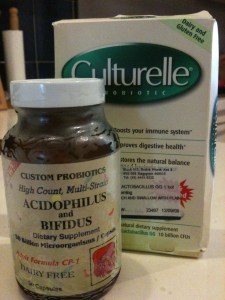
You can also treat clostridia with Culturelle. Culturelle is the brand name for Lacto GG, a strain of probiotics that are particularly effective against clostridia. It is said that Lacto GG is the most researched probiotic in the world. Best of all, Culturelle is also casein-free, compared to other brands of Lacto GG. Some children react better to Culturelle compared to Flagyl. Dr William Shaw, founder of Great Plains Lab, who is also a highly-respected biochemist in the biomed world, finds that Culturelle is more effective in addressing clostridia long term compared to Flagyl. He believes that treatment by Flagyl alone results in 100% recurrence in clostridium infection. However, by either using Culturelle alone or in combination reduces the recurrent infections tremendously. Reason being, clostridia is a spore-former, therefor Flagyl is not effective against the spores itself, only on the bacteria. The spores are the guys that reproduce and make more ‘baby clostridias’. Thus it would make sense to have a treatment protocol that address both the bacteria AND the spores. Please sign up to the Great Plains newsletter at www.greatplainslaboratory.com . You will also receive a free e-copy of Dr William Shaw’s book Biological Treatments for Autism & PDD, a staple in every biomed home.

Some children experience terrible die-off symptoms either from Flagyl or Culturelle or both. Some parents are happy to see bad die-off, thinking that it means it is killing the infection effectively. I would like to dispel that myth, some die-off can be expected. But really bad die-off is not good. It means that the body’s detox system is overloaded, that they are not able to detox or flush out the by-products effectively. At this point, please consult your doctor, you may need to reduce the dosage. On the other hand, no die-off or very mild die-off doesn’t necessarily mean that it is not working. Just count yourself lucky. Remember, if the child seems in a lot of pain, terrible discomfort, not able to sleep for many nights, really bad diarrhoea, continuously crying and mega tantrums, it is a sign to take it down a notch. Activated charcoal, Alka Seltzer Gold and Epsom Salts baths helps to reduce the die-off.

On the other hand, there are some parents who are so fearful of possibly bad die-off, that they prefer to not address the infections. Fungal / yeast, bacterial and parasitic infections causes terrible itch, pain and discomfort in the tummy, bowels, skin, genitals and anus. Please, don’t be put off by the die-off horror stories. If you yourself have ever had a yeast infection, you know how horrific it is to live even 1 day with the itchy scratchy pain in your nether regions, so imagine if it is a systemic yeast infection in your child, imagine the pain and discomfort he is experiencing. If you fear the die-off, consider that the treatment is only for a couple of week, after which you child will be left feeling a whole load better, pain free and itch free. 2 weeks of tantrums and sleepless nights compared to a life-time of happiness. Don’t let your own fear hold your child back. Don’t let your own fear of sleepless nights or dealing with tantrums deny your child the medical attention he needs. If you do decide to take the plunge, and if the die-off is too unbearable, remember that you always have a choice to reduce the dosage or stop it altogether. Having activated charcoal on hand helps. A
t the very least, you can tell yourself that you tried your best for your child.

For my girls, I have tried Flagyl and Culturelle, both singularly or in combination. We have done Flagyl for 2 weeks, then followed by Culturelle at a maintenance dose. I have also done only Culturelle at a therapeutic dose for 3 weeks, then reduced to a maintenance dose. Both have been effective for us, the incidents of recurrence have been manageable provided that we always include a maintenance dose of Culturelle daily. There was a time 2 months after Yasmin’s last Clostridium infection which we treated with Flagyl followed by Culturelle, we ran out of Culturelle. After 3 days of missing it, all the symptoms came back with a vengeance. The shouting and tantrums, poor appetite, night awakenings and severely bloated tummy points to clostridia again. Based on our doctor’s advice, we put her on a therapeutic dose of Culturelle. It did the trick, after the first week, we could see a reduction in the behaviours and physical symptoms. Since then on, I made sure we never ever ran out of Culturelle again.

There were times that therapeutic dosage of Culturelle was not enough and we had to resort to the Flagyl/ Culturelle combo again. But for us, maintenance is the key. Without daily dosing of Lacto GG, the highly opportunistic clostridium WILL come back. Also, we made sure that the girls get high doses of multi-flora probiotics post antibiotic treatment. My current favourite probiotics are Custom Probiotics CP-1. It is 50 Billion CFU, it is casein-free and strep-free multi-flora combination of Lacto and Bifido strains. I also supplement with S.Boulardii as it is also helpful with the fight against dysbiotic flora. If you have a child who is prone to recurrent infections like I do, addressing the immune system imbalance concurrently is a must.

Flagyl is a prescription antibiotic, you can get it from your prescribing doctor. Culturelle comes in 1 Billion or 10 Billion CFU, I always make sure I get the 10 Billion CFU ones. Culturelle is usually stored and shipped unrefrigerated, it comes in specialized foil packaging that protects it during transport. However, it is always recommended to store all probiotics including Lacto GG in the refrigerator once you receive your shipment to ensure potency. Culturelle is available at www.iherb.com, www.spectrumsupplements.com, www.b2bdiet.com.sg and autismrecovery.com.sg.  You can purchase Custom Probiotics at www.customprobiotics.com. All the above stores delivers to Malaysia.

A friend reported that her child was diagnosed with anaerobic bacterial infection by her peadiatrician. Based on clinical symptoms and physical examination, he prescribed a 3 day course of Flagyl. I spoke to her about Culturelle and once the course of Flagyl was finished, she put her child on a therapeutic dose of Culturelle. Funnily enough, the 3 day course of Flagyl didn’t seem to cause any die-off nor improvements in her child. However, on the 2nd day she was on Culturelle, her daughter experienced die-off behaviours- irritability, crankiness, fatigue, non-compliance and poor appetite. Take note that this is a neuro-typical child with absolutely no Autistic symptoms.

Finally, her daughter did a massive bowel movement. My friend couldn’t believe how much came out of her child, to the point that she insisted that her husband and the maid look at it. They feared the toilet bowl was going to overflow, gross yet fascinating, they couldn’t look away. She was so concerned for her child, yet the texture and appearance of the stool was normal, the only abnormal thing about it was the amount. It seemed more than even an adult could produce, much less a skinny 5 year old child. However, right afterwards, her child said to her that she felt much better. She then was ready to eat and had a healthy appetite again. It is amazing how quickly a child bounces back. Since then on, she is a big believer in Culturelle. This is a gross story, but something only a biomed parent can appreciate. In fact, when my friend called me about it, she was so amazed by what happened on that day and she knew that I was the only person who would appreciate such a story. And yes, I did.

>Preparing for the Endoscopy

>After procrastinating and indecision for the past few months, we are finally getting the endoscopy and colonoscopy done for Yasmin. The procedure is for diagnostic purposes, rather than a treatment. Hopefully the scope and biopsy will shed more light on Yasmin’s medical problems. It will tell us of any inflammation, damage or lesions in the GI tract.

Yasmin is a mess of GI and Immune issues, every treatment and tests we have done keeps leading us back to her gastrointestinal system. Several doctors have recommended we do the endoscopy and after several consults, the Pediatric GI Surgeon is now convinced that there is due course for the investigation.   

Physical symptoms, behavioral regression, bouts of pain, recurrent bacterial infections, susceptibility to illness, chronic diarrhea for the past 10 months, poor appetite, no weight gain, disturbed sleep- her pain and suffering seems endless to us. So, no more chickening out, we are going through with it.

A part of us are scared that we make her go through the procedure and in the end, the doctor finds nothing is wrong. If so, then we’ve hit another dead end. Another part of us is scared that we WILL find something wrong.

Yasmin was admitted into hospital yesterday, however the procedure will only be done today. The preparation takes 24 hours prior to the scope. Yesterday, I had to get her to drink 1/2 litre of laxatives. It was an extremely hard task, getting her to drink it all.

After that, I had to make her take a sedative. When she finally fell asleep, the nurses did a rectal wash, similar to a colonic irrigation. However, it didn’t totally clear her bowels up as much as we had hoped. So this morning, we had to do the whole thing again. This time she had to drink 1 litre of the laxatives. She did a massive bowel movement (no big surprise there!) thankfully. Then we had to give her the sedative 3 times, after much struggling, spitting and gagging we managed to get enough into her that she finally fell asleep.

The nurses did another rectal wash, thankfully like yesterday she sleet through the whole thing. However, she woke up pretty soon after if was finished. Nothing keeps my Warrior Princess down for long.Throughout it all, Yasmin was happy and cheerful yesterday and today. She is still her loving, affectionate self. She is such a trouper!

Paul was overseas and was only coming back to KL last night, but we didn’t want to postpone it for much longer as we needed to book the doctor, anesthetist and operating theatre beforehand.Though initially I was very apprehensive admitting her into hospital without Paul around yesterday, i kept telling myself not to let my own fears stop me from doing what’s best for my daughter.

Now, Yasmin is to fast until the procedure, she is hungry and cranky. It’s hard to deny her any food or drink, it was even harder getting her to swallow everything required. But if her bowels and upper digestive system are not cleared completely, then the scope may not be successful. The doctor may not be able to view anything, if there was too much stool left even worse the doctor may end up rupturing parts of her due if the view isn’t clear.

My biggest worry is the general anesthesia. I personally had a bad time coming out of the GA, it changed my behavior and demeanor. It took me several days before I was finally myself.

Yasmin is such an amazing girl, her capacity for love and forgiveness is enormous. Even after the times when I had to force feed her horrible meds, after the shouting, struggling and tears,  when all was done, she would turn to me, hug and kiss me. And when I said that I love her, she said “I love you too, Mummy”. If only we can all forgive and forget so easily, the world would be a better place.

I pray for a safe and successful procedure. I hope there are no long term side effects from the anesthesia. Most of all, I hope this will finally shed some light to Yasmin’s underlying medical issues.         

>The Rash Incident…..

>

The past couple of months have been very taxing for our younger daughter. She had several rounds of fevers, colds and coughs on top of her chronic diarrhea which has been going on for 9 months now. There were also 2 absolutely horrendous weeks of hive-like rashes called urticaria. It started from her legs and progressively spread all over her body, the itching intensifying every day. Initially, the rash and itching was isolated, but everyday there was a little bit more. In the first week, with the help of our local GI paediatrician, we managed to control the discomfort whilst investigating the cause. However by the 8th day, my little girl was in absolute agony. She would cry and scream trying to scratch herself and not finding any relief.

This is the first time this has every happened, I don’t recall this kind of rash happening to either girls before. Paul and I felt so helpless, watching our little girl covered from head to toe in huge red welts, her hands and arms were swollen. During that 2 week period, we went to see a doctor just about every single day, we ended up seeing 4 different doctors. It seemed that nothing seemed to help, the antihistamines, painkillers and other remedies or drugs did not reduce the swelling nor provide relief for the itching.

In the 2nd week, for days and nights Yasmin would cry nonstop and madly scratching herself. We used calamine lotion, 3 types of antihistamines each stronger than the previous and other treatments. For the first 3 days there was some vomitting and mild fever. But later, there was no more vomitting but with intermittent high fever that doesn’t recede with ibuprofen or panadol. Only voren suppositories could bring down the fever.We did a blood test for kidney and liver function and mycoplasma, they turned out to be negative, but the markers were slightly elevated in one of the liver function profile.

Everytime Yasmin was not in an air conditioned room, the itch intensified and her fever spiked. The 1st week of rashes also coincided with the day of the conference in Singapore, which Paul and I were looking forward to. We didn’t want to miss hearing Dr James Partington and Dr Kenneth Bock’s talk, it’s a rare opportunity to hear world-class Autisms expert talk for 3 hours each. But neither could I bear to leave my sick child at home even though my parents were willing to take care of her.

Paul and I decided to pack up the whole family and drove down to Singapore the day before the conference. We also managed to get a quick consult with the girls’ regular doctor there and get a 2nd opinion. We managed to keep Yasmin somewhat comfortable though we could see the rashes were still bad.Nontheless, the girls love going to Singapore and especially love staying in hotels. They were happy enough and we didn’t feel too bad about taking Yasmin away on a trip, even though we should never take a sick child travelling. Right or wrong, it was a choice that Paul and I made.

The next morning, it was hard to concentrate on the presentation. I was incredibly tired from repeated sleepless nights caring for Yasmin plus I had bronchitis. God, please forgive me for spreading my germs to the other parents who attended the conference. Though I had heard both Dr Partington and Dr Bock just a couple of weeks before that in Hong Kong, it was still incredibly beneficial. You just can’t learn enough I feel. It was also good to meet new friends and catch up with old ones, though in the back of my mind I was incredibly worried about Yasmin. She was never far from my thoughts even though I was chatting to people or concentrating on the biochemistry lesson courtesy of Dr Bock. Paul was kind enough to stay with the kids and our nanny while I went to the conference first for Dr Partington’s lecture. He made sure Yasmin was stable enough and that he could safely leave them for a few hours with our nanny. Paul managed to join in for Dr Bock’s portion. Our hotel was only a few minutes drive away so we knew that in case of an emergency phone call from the nanny, we could rush back to our girls quickly.

The day after the conference, before we drove back to KL, we also saw a pediatric immunologist in Singapore. We also wanted to make sure that Yasmin would be ok for the 4 hour drive home, to have some temporary solution so that Yasmin won’t be too uncomfortable during the car ride. The doctor was very concerned about her immune system and recommended that we see an immunologist in KL for further investigation. She suspects the fever and rash was a viral infection rather than an allergic reaction. She gave us some medication to control the fever and itchiness. The drive back to KL wasn’t too horrific, thank goodness.

Back in KL, we saw our regular pediatrician again and we also managed to get an appointment with the only pediatric immunogist in Malaysia. They are working together to investigate Yasmin’s condition, namely inflammatory bowel disease and her impaired immune system. Our consults and testing with the immunologist unfortunately could not bring us any closer to a resolution. But by then, he had identified enough that her immune system is compromised and everything led back to issues with her GI disorder. After all, 70% of our immune system lies in the GI tract. Again, the topic of endoscopy had come up.

Yasmin’s rashes and fevers went away after a course of antibiotic, our paediatrician prescribed it because the rashes were so bad that it caused swelling and infection of the fat layers of her skin. The Rash Incidence has been so traumatizing for us that it took me a long time to even be able to talk about it or write about it till now, 2 months later. Since then, based on the recommendations from our doctors, we have taken steps towards getting closer to healing Yasmin. We did an xray which confirmed fecal impaction, thus we put her on laxatives and enemas. This gave her much relief, her tummy was no longer bloated, her mood and behavior improved and her appetite was much better. However, after some time, the symptoms would return. We have also been battling constant colds, flus, fever and coughs. Till now, I dread the rash would return. The Rash Incident was more traumatizing for us compared to her previous hospitalizations, can you believe it?

I also finally had the time to read Dr Andrew Wakefield’s book Callous Disregard. This turned out to be very timely for me, as Dr Wakefield included many case studies of children he’s worked with. There were many references to bowel disease, immune dysfunction, chronic diarrhoea, behavioural issues  due to GI disease, endoscopies, gastrointestinal symptoms – everything that I was going through with right now. It is a huge loss to the medical world indeed and Autistic children worldwide that a gifted paediatric gastroenterologist was struck off the medical register due to biased misrepresentation, government blunders and the profit margins of vaccine manufacturers. Meeting him again in Hong Kong and listening to his lecture also gave me the resolve to go ahead with the endoscopy. Paul and I had many misgivings about doing the procedure for Yasmin, but now our fears have been allayed. I also read again Dr Elizabeth Lipsky’s book Digestive Wellness and anything else that related to IBD and GI diseases.

I am working closely with my pediatric GI doctor as well as the peadiatric GI surgeon who will do the actual procedure. We are in the midst of preparing for the endoscopy and possible colonoscopy, which will also include more consultation, scheduling and booking the operating theatre and anaesthesiologist, blood work and biopsy. All her symptoms and conclusions from the many doctors we consulted points t
owards IBD, Inflammatory Bowel Disease. So now we are STILL in the initial stages, which is getting a proper diagnosis of which type of IBD or another type of GI disease. However, I am hopeful that we are on the right path. Once the endoscopy and findings confirm it, we can then proceed with treatment. What the treatment will be depends on the diagnosis. And if everything comes up negative, I will deal with it when the time comes. Right now, diagnosis first……..

>My Top 10 Favourites……

>

There are several supplements and treatments that come high on my list of favorites. Every parent has their own list, it differs from child to child. I would like to share what were the top supplements and treatments that have made the most impact in my children.
This is a list of our Top 10 favourite treatments;
      1.    Methyl B12 – Maya showed amazing leap in language abilities. After reading up on the benefits of B12 and the many types of administering, I decided straight on that I wanted that is proven to be the most effective ie the methylated form of B12 ie. Methylcobalamin.  Extensive studies have shown that subcutaneous injections of methyl B12 to be far superior to other forms eg. Transdermal, nasal or oral. Though we were horrified at the thought of injecting our girl almost daily ourselves, we keep repeating the mantra “A few seconds of pain, a lifetime of happiness” every time we did it. It has been 1 years since we first started, and we will continue to do so as we still notice a difference on the days that she misses a shot for a day too long. We are now doing preservative-free MB12 at 0.05ml 3 x weekly. Take note that MB12 needs to be done as a part of an intensive biomedical protocol, it is not a 1st tier supplement and you need to consult a Biomed doctor as to whether it is appropriate for your child and when is the best time to introduce this. MB12 is available from specialist compounding pharmacies, please order it through an experienced DAN doctor. Other doctors may not know the difference between the other types of injectable B12s. Also, MB12 must be introduced at the appropriate time, you must work towards prepping the body for it. Otherwise you either end up with no improvements at all or worse, more hyperness. It is available in either pre-filled syringes or in vial form. I prefer in vial as it is a lot more cost effective compared to pre-filled syringes.
2.    Diet – gfcf, egg free, soy free. We did a period of low-sugar for 6 months, that helped a lot in reducing the yeast overgrowth. We only tried corn-free and low salicylates diet 9 months after starting intensive biomedical, but by that time Maya had made tremendous progress. So any benefit if any seemed inconsequential. Subsequently after 2-3 months trial, we went back to the normal GFCFSFEF diet. For now, we still continue the GFCF diet though on special occassions with occasional gluten allowed. Even until now, we noticed almost immediate behavioural regression whenever she has casein.
3.    Probiotics – we do high dosage multi-species casein-free, strep-free, refrigerated probiotic formulations. Dosage ranged from 20-100 Billion CFU depending on what protocols we were doing at that time. Our kids need high doses of many types of Lacto and Bifido strains. After some time, we found that probiotics containing strep strains eg. Kirkman’s Probio Gold and Klaire Labs’ Therbiotic Complete weren’t suitable for my girls as strep-free versions. I now rotate between Klaire Labs Therbiotic Detox, Custom Probiotics and New Beginnings Probitics. I also love Culturelle, a casein-free version of Lacto GG. This is effective in fighting clostridia. Klaire Labs products are only available through doctors, other brands can be purchased anywhere.
4.    Anti-fungals – From the very first anti-fungal protocol we did, Maya showed amazing improvement every time. It took several rounds of different anti-fungals to finally keep it under control, however from time to time we still need to address yeast overgrowth. Diflucan, Ketoconazole, Nizoral, Augmentin, Sacchromyces Boulardii and Candex are some of our favourite anti-fungals that have been particularly effective in our girls. There were others we tried, but due to the taste, we weren’t able to follow the protocol as set by our doctor. We always keep stock of S.Boulardii, I rotate between Klaire Labs and Kirkman’s. As with nearly every treatment, please consult with your doctor when implementing an anti-fungal protocol.
5.    TMG – this is a methyl donor, important in the methylation cycle which is frequently impaired in ASD children. As usual, we started at a low dosage and slowly worked up to the maximum dosage. However, we found that Maya only needed 3/4 of the dosage, 750mg seems to be the ideal amount for her. She could finally tolerate wearing clothes and was no longer agitated when wearing clothes. She was more compliant when dressing and started to wear blouses with sleeves and wearing pants. Before this, she only wanted to wear dresses with thin shoulder straps. Best of all, we saw a huge leap in potty training. You have a choice of either TMG or DMG, depending on your child’s needs, please consult a doctor on which one is suitable for your child. After trying several formulations, I prefer to stick to single formulations rather than mixed ones. You can find TMG mixed with B12 and Folinic Acid. However, some DAN practitioners do not approve of oral B12. I now use Kirkman’s TMG
6.    OSR – also known as Oxidative Stress Relief, this is a powerful antioxidant. After 3-4 months on OSR, Maya’s oxidative stress levels went down to normal range. Previously, she was “Oxidising like crazy!” as said by Dr Mark Westaway. We only used this for 4 months and during those months, Maya kept progressing and improving almost daily. OSR is available from Lee Silsby Compounding Pharmacy and can only be ordered by a doctor. In South East Asia, for the moment only Dr Erwin Kay stocks this.
7.    5-HTP – we only started using 5-HTP only a few months back. From seemingly out of nowhere, Maya started presenting negative though processes and had a lot of anxiety issues. She was very moody and obsessed with dark, spooky stories. We tried several interventions with no luck, however the moment we started her on 5-HTP, the negative thought process and anxiety disappeared. I was still sceptical, and recently w
e ran out of 5-HTP for a few days and true to form, the anxiety and moodiness returned. This is a supplement that we make sure we never run out of these days. I use Klaire Labs 5-HTP
8.    Magnesium – physical symptoms and test results showed that Maya was deficient in Magnesium. Not only that, her body seems to be excreting it quite fast compared to other minerals. Magnesium has helped her in many ways, mostly it’s calming properties ensure that she’s calmer and sleeps well. It also relieves her constipation. After trying many many formulations, we finally found one that tastes good. Most Magnesium Glycinate tastes horrid! ASD kids are recommend to take Magnesium Glycinate, rather than other forms as it is the least irritating to the gut and well absorbed. Our favourite is Kirkman’s Magnesium Glycinate Powder Biomax.
9.    Transfer Factor and Colostrum –  these are immune `enhancers’. They are 2 very different products, but both seeks to modulate the immune system by transferring the correct information to our immune system. Colostrum is bovine-derived and contains casein, however the benefits far outweighs the casein issue.  Transfer Factor is a class above Colostrum, it works rather differently.  My girls are prone to colds, flus, fevers and other infections. However when I started to use both these supplements together, we have a miraculous illness-free period for several months. Unfortunately, whenever we run out of stock, my girls get sick again. I use Kirkman’s Colostrum Gold. Dr Erwin carries Researched Nutritionals’ Transfer Factor. I am trying to source other brands of Transfer Factors as they always run out of stock.
10.  Digestive Enzymes – DPP-IV and Phenol Assist are one of the first supplements to start on. Most ASD children are very deficient in DPP-IV, an enzyme that processes casein and gluten. It also plays an enzymatic role in the immune system, though it is called by another name. Phenol Assist helps to digest phenols, oxalates and salicylates. After a long time on a strict GFCF diet and daily doses of DPP-IV and Phenol Assist, late last year, we went on holiday. We allowed both girls to have all the gluten, casein and junk food they want. We also made sure they have lots of DPP-IV and Phenol Assist. Neither girls had any bad reactions to the lapse in diet. I use Kirkman’s Enzyme Complete DPP-IV with Isogest and Kirkman’s Phenol Assist. I have tried other formulations, but the girls didn’t like the taste of them eg. Trienza, No-Fenol. So, we continue with what works for them and what they can tolerate the taste of regularly. Digestive enzymes cannot replace the importance of a strict GFCF diet, as well as restrictions in oxalates, phenols and salicylates. 
There were a lot more supplements we have tried, on any given day, my girls take an average of 20 supplements daily. And throughout the years, we have tried supplements that have given us amazing results, as well as those who caused the worse regressions. Though biomedical intervention done well is backed by evidence-based medicine, research and through testing, at times we will not know how well a child will respond to the treatment until we actually try it. What may work for my child may not work for yours. Please work closely with an experienced biomed doctor, first and foremost keep your child’s health and safety in mind, keep yourself educated, keep track and monitor each and every day. Most of all, keep a positive outlook. Good luck!

>More Recovery Stories

>In the past few years of living in Autism-Land, many people have come up to me and said that they have never heard of recoveries in Autism. We are told that Autism is a life-long disability and that behavioral therapy is the only treatment available. Before Maya was diagnosed, I have never even heard of Autism (except for Rain Man of course) therefor I didn’t have much of a pre-conception about the prognosis. The first ever book I read which also gave me an inkling that Maya probably had Autism was by Jenny McCarthy. Her son recovered from Autism. When we finally received Maya’s Autism diagnosis, I vowed that I will recover Maya. If Jenny can do it, so can I. Whether we live in USA or Malaysia, Autism is Treatable. Please read the article below courtesy of my favourite Autism magazine, The Autism File. 

No Longer Autistic by Lisa Mize
Courtesy of Autism File

>Treatment Protocol Plus A Dose of Fun

>

With every treatment or supplement we do, we always do it with the advice of a medical doctor. We follow the set protocol and usually get 2nd opinions on nearly everything. I don’t try out anything without a doctor’s recommendation or advice, I am very conservative and like to go slow and steady. I never start more than 2-3 new supplements in 1 month. I always start at a low dose and slowly work up to the recommended dosage. We keep meticulous record of everything we do and keep track of any side-effects, bad reaction or improvement made with each supplement or treatment. Though a lot of parents are brave and bold enough to implement a treatment or do biomedical treatments without the guidance of a doctor, I’m quite conservative. Slow, safe and steady has been our approach and so far, it has served us well. To a lot of other parents, my approach is very slow and far too conservative for their liking. However, we all have our trusted methods, this so called “slow” approach has given us tremendous progress. This is a brief overview of our treatment plan since we started biomedical treatments.

As you may know, we started on the GFCF diet and didn’t pursue biomed for another 6 months. Once we started intensive treatment, sleep and constipation was high on our list of priorities. Then I wanted to address Maya’s other gut issues. Next, we started on our first round of anti-fungal treatments, this is one of her biggest problem. At the same time, we addressed her oxidative stress. We then addressed her inflammation as well as implemented a biofilm protocol. After that, we worked towards prepping her for MB12. We finally found the right dosage and frequency for MB12 and saw amazing results.

We have done several tests at different points in time, some more than once depending on the need. We tried an anti-viral treatment with good results, but we couldn’t pursue it further for the moment and had to be put on hold. We then concentrated on her methylation cycle – all the methyl donors eg Taurine, N-Acetyl Cystein, Folinic Acid, TMG and MB12 worked amazingly well for her. Each supplement showed good reactions; Maya was calmer, there was a sudden leap in clarity, cognition and language. We continuously had to address yeast overgrowth from time to time. We were also working towards balancing her immune system. We also investigated strep for possible PANDAS (Paediatric Autoimmune Neurological Disorder Associated with Streptococcus) though thankfully this turned out to be negative. Her long-term issue with dressing and wearing clothes were addressed, as well as finally able to toilet-train.

From time to time, some new issues would come to the fore such as her negative thought process and recurrence of anxiety and controlling behaviour. This was resolved quite quickly with the help of our doctors. Currently, we are prepping her for chelation and have just done the pre and post challenge test with showed a good excretion rate. Recently we did another round of the RBC (Red Blood Cell) test which tells us the levels of minerals, this is by far the most accurate test for mineral levels. We also did the kidney and liver panel again as well as viral panel to test for a range of viruses.

As always, for every treatment we have done successfully, there are always several supplements or treatment that were either ineffective or worse, caused regression. However, by only introducing one new supplement at a time and close monitoring, we were able to quickly identify the cause and immediately address it. At times, there were regression due to illness or side-effect from certain treatments, however each and every single time she always recovers the skills and progress made and comes back to the level where she was previously. There are shelves full of half-opened bottles of supplements that we no longer use, though it seems like a waste of money, we would never have known if those supplements or treatments would have worked for us or not. Looking back, we tell ourselves that we tried it. Some treatments have shown amazing results, but as with life, sometimes failure happens. If a treatment failed, we try again and keep going forward. We try to maintain a positive outlook and try to see the funny side of things whenever possible.

Maya is recovered from Autism and no longer requires behavioural therapy or special services. However, we still continue to pursue biomedical treatments to address other lingering health issues. Our challenges for this year will include addressing her heavy metal load especially mercury and will start chelation with DMSA very soon. We will investigate further into viral infections and we continually seek to address her immune dysfunction. Occasionally, she is prone to colds, flus and fevers.

Maya is a happy little girl who is thriving well at school. She has lots of friends and enjoys the same activities as other little girls. She has taught herself to play simple songs on the piano and loves ballet classes.  Maya  has a great personality and has the same sense of humour as her daddy. They have great fun and adventures together and you can frequently hear them giggling and laughing over some private joke together. 

>A Good Night's Sleep

>

I was recently reminded by how good sleep is generally in our home right now. It served to remind me to appreciate and not take for granted the good night’s sleep that we have all enjoyed for the past year or so. For the past 3 months, both the girls have been falling ill constantly. As usual, when children are sick, it also affects their sleep as well as the parents sleep. Having just come back from a quick little holiday with Paul, just him and I alone, we both enjoyed 2 nights of great sleep. Looking back, the sleep fairy has been extremely good to us in the past year. I had forgotten all the sleepless nights we had and how I used to crave even a straight 3 hour stretch to sleep. As a Mum, if your kids don’t sleep, YOU don’t sleep right? Since sleep disorders are a common issue for most ASD kids, I needed to remind myself of the luxury and privilege that I now have, a guaranteed good night’s sleep most nights. Nowadays, if they’re not sick, both girls would be in bed by 7.30pm and would stay asleep until 6.30am. Usually they will fall asleep by themselves without much fuss, but occasionally they would cheekily get out of bed again, so we would have to tuck them into bed again a few times, read countless bedtime stories and sing lullabies. But being the ungrateful parents that we are, Paul and I would moan over the 6.30am wake-up calls of them jumping on our beds, giving us kisses and cheerful “Good mornings !” How times have changed, how easily we forget…….


When we first started intensive Biomed, we worked out our priorities together with the doctor. This determined the first course of action and treatment and addressed our most pressing issues. First and foremost was sleep! Throughout Maya’s entire life, even from the day she was born, she always had sleep issues. A typical newborn would stay asleep for 23 hours a day, whereas Maya would be awake for 12 hours a day. For the first few months of her life, she hardly ever stayed asleep long enough like other kids. She would fall asleep while breastfeeding and I remember having to wake her up so that she could drink her fill. When she was a baby, she hated sleeping in her cot, preferring to sleep in our bed, tucked between the 2 of us. Unfortunately, though she would sleep, Paul and I couldn’t for fear that we would accidentally squash her.

When she was born, we had 4 main issues to deal with. I had difficulty breastfeeding her, getting her to sleep or stay asleep, dealing with constant pooping and her constant crying.This was going to be a pattern for much of her life.  Breastfeeding was hard!! She had difficulty latching on, she couldn’t suck properly, the milk flow would be too much for her causing her to gag, she would scream for milk, but when trying to feed, she’d scream as if in pain. I had mastitis twice and was on antibiotics while breastfeeding her. Her feeding was so erratic that it affected my milk flow, there were 2 occasions when my milk supply dried up. I had to painstakingly express milk all day long for up to a week trying to get my milk supply up to the previous level. Even when I expressed milk and fed her by bottle, she needed the slowest flow nipple and could only drink not more than 2oz at a time.  If she drank too much or too fast, she would projectile vomit. I remember many many times of cleaning up the car, the bed, the floor and changing her outfit and mine many times a day due to her throwing up. She required small feedings very frequently. I remembered breastfeeding her every hour for the first 3 months. When she was 4 months old, she only needed feeding every 2 hours. 


At that time, I knew that the mother’s diet would affect the breastfed baby, thus I was careful of avoiding caffein during and after pregnancy. Also friends and family had reminded me to stay away from foods that caused “angin”. However, in hindsight if I had known to stay off casein and gluten too, things may have been different. Even though at that time Maya was never fed any formula or milk-based products, I didn’t realise there was a lactose, dairy or casein issue involved. A child can still ingest it through the mum’s breast milk. When I was breastfeeding, I was constantly hungry, I craved chocolate milk and yoghurt. There were many varieties of yoghurt in Sydney and I loved the  fresh greek yoghurt with mixed summer berries from David Jones, Paul would buy me tubs of it. I also ate freshly baked gourmet breads and pastries everyday, now I know better…….. 


After 7.5 months of breastfeeding, Maya refused to drink from me and preferred the bottle so we moved her on to formula. I envied those other mums whose kids would drink a huge bottle of milk in one go, then fall asleep for hours. With Yasmin, it was so different. She slept well, she fed well and we only had to change her nappy 6 times a day. Because Maya was my first born, we didn’t know any better. We thought 12 poopy nappies a day was normal. We thought feeding every hour was normal for a 3 month old baby. But what I knew was abnormal was her sleeping only for 20 minutes at one time. However, no one could give us any insight on it. 

Since she was 3 weeks old, Maya would scream and scream from 6pm until 10pm every night. This went on for 4 months! We would try to feed her, change her, rock her, swaddling, anything that would calm her down. Usually, swaddling her very tightly and rocking and swaying her hard whilst walking around and around very fast would help. For 4 hours every night, Paul and I would take 1 hour shifts, both of us trying to soothe her. Yet, she would continue to scream bloody murder. Doctors would tell us it was colic and gave us some anti-colic medication which didn’t work. We were exhausted and worried about our child, but we could’t find any answers. Her crying was always high-pitched at the loudest volume, her cries were so blood-chilling that people were afraid to come to our house or invite us anywhere. We finally had an inkling that Maya had sensory issues, whenever we took her out to the shops or for an outing in the day, at night her screams were more frantic and lasted longer. If we kept her at home all day long, with no distractions or visitors, she would have an easier night. She’d still be screaming, but it was only for 4 hours, rather than 6 hours straight. This eventually got better, especially since we finally got a maid when she was 4 months old. For the first time ever, Paul and I managed to sit down to eat together while the maid would rock and soothe Maya. I remember days when I never had a chance to sit down, because Maya needed to be carried and rocked all the time.

When we finally weaned her on to solid food, it was a struggle. She did not like to eat. Mealtimes would take up to 1 hour, just to coax 2 tablespoons of food into her. She continues to be a picky eater up to this day, with a very small appetite compared to other kids. However, when she was 1.5 years old, I moved her on to fresh milk. She loves it so much and could drink up to 1 litre a day, which is a lot for her. And she loves bread, she would happily eat bread and drink milk all day and nothing else. We noticed the addiction, but nontheless we were happy that we could feed her nutritious meals by making pizzas and sandwiches which also contained protein and vegetables. We noticed her love of milk, but we have been taught that fresh milk is good, lots of calcium and nutrients right? She would drink a 6oz bottle, then she would be all dopey and sleepy and goofy. She acted like someone on drugs, all high and woozy. Initially we thought it was funny, until years later we learnt about the opiate effects of casein and gluten. 

She would have explosive bowel movements 12 times a day in the first 3 months. We did not know this was abnormal. And once a day, every day, her poop was so explosive that it would burst out of her nappy and cover her entire body. Her little bodysuit would be soiled from the knees up till halfway up her back, sometimes she would be covered in her poop from her neck down to the ankle. We threw out so many outfits because it would get so soiled.  She also had nappy rash, again and again. We were still in Sydney at the time and when I showed her poopy nappy and her red sore bottom, our well-respected and experienced Australian paediatrician said fully breast-fed babies are not supposed to have diarrhoea and they are not supposed to have nappy rash. Errr……… “Doc, I don’t care whether they’re SUPPOSED to or not, but you can see for yourself the diarrhoea and the nappy rash. I fully breastfeed her, yet she still has diarrhoea and she has bad nappy rash”. He didn’t have any answer for that, just kept saying that she’s not SUPPOSED to have them. I don’t care what medical books say, she DID have them, so help me out here will ya? Can you explain this doc? Can you help my baby? 

From the very first day she was born, Maya didn’t sleep well. Paul spent the 4 nights in hospital with me, sleeping on the floor.  The hospital advocated the baby sleeping or rooming in with the mum immediately from birth, in order to facilitate bonding. There were no nurseries where babies are placed, all babies roomed in with the mums unless they were in ICU or if the mum had complications. The nurses would always be on hand to help, but Paul was and still is an amazingly hands-on dad. Because I couldn’t get up from bed for a few days after the Caesarean birth, Paul took charge of changing her nappy, rocking her and burping her. He even gave her her first bath, even for the next few weeks after because I was afraid to bathe her myself. In hospital, Paul would hand Maya to me whenever she needed to be fed. She would not sleep in her bassinet, preferring to sleep cuddled up next to her Daddy even from her very first day. She loved being held by Paul, he would sleep on a mattress on the hospital floor in my private room. She would cuddle up to him, her little face tucked against his chest. Only then, she would sleep peacefully. I remember nights in the hospital when she would scream and scream and I was not able to get up from my bed. Paul would rock her all night long, walking down the dark hospital corridors while trying to soothe her. Even while we were all holed up in hospital, Paul still had work to attend to and would try to catch up on his emails. He would sit on the floor in front of his laptop, Maya cuddled up in his arms whilst typing out an email. 


As a young baby, Maya would fall asleep for 20 m
inutes and stay awake for 1 hour, then sleep for another 20 minutes and so on. By the time she was 2 months old, at night she eventually managed to sleep for 2 hours straight. Then wake up again for another hour to drink milk, a nappy change, then another half hour of rocking her back to sleep and she would sleep again for 2 hours. Usually, she would wake up cranky and crying, even after a somewhat long sleep. This was how life was like in the first years of her life. 
However, when she was 1 years old, she finally managed to fall asleep by herself without much difficulty and would sleep for 12 hours straight at night. We would limit her daytime naps to only once a day, and then only for 1 hour. We wouldn’t let her nap too late in the day, otherwise she would be up all night. It was mean, but that was the only way we could cope. However, even though she slept well at night, during the day time was very tough. We had to deal with her tempers, meltdowns and mood swings. It wasn’t quite as bad as after she regressed into Autism, but it was taxing enough for us. 


But throughout all the difficulties and challenges, Maya developed and achieved all the milestones at age-appropriate levels. Her growth chart and well-baby visits recorded normal development. She received all her vaccinations on time and we combined both Australian and Malaysian vaccination schedules. Therefor Maya received more vaccinations than the average Australian or Malaysian child. Her last vaccination was for Meningococcal C. She was 1.5 years old then, about 4 months after her MMR and Varicella vaccination. We were living in Sydney then, the vaccination was give 1 week after Yasmin was born. Before that, there were many videos and photos of how happy and interactive Maya was. She didn’t really talk spontaneously, but she would label things on the posters for us, when asked where’s Mummy, she would point to me. When asked who that was, she would happily tell us their name. She had a big vocabulary and could count to 20, she knew all her alphabets. Though she never did call me Mummy ever, she knew where I was and would always want my attention and be with me. She had a sparkle in her eyes, she was full of fun and played well with other kids.

Looking back, we realised she started to plateau developmentally and she slowly regressed. She talked less and less, her tantrums and aggression were worse. She retreated more and more and preferred to be alone and her sleep deteriorated. Maya constantly would wake up in the middle of the night and stay awake for 2-3 hours, singing, laughing or talking to herself. Or it would take her a long time to fall asleep. She also kept getting constipated, medical records showed many visits to the doctor with a prescription for more laxatives. And her behaviour and condition deteriorated until she was finally diagnosed with Autism.


Unfortunately, only years later with the hindsight I have now, I now understand why Maya was such a difficult baby. And why she eventually regressed and became the 1 in 100 to get Autism. 

Obviously, when we started biomedical, sleep was our first priority, years of sleepless nights has taken it’s toll on us. So getting her sleep sorted out was by far the most important thing for us, rather than the Autism behaviours. Dealing with her behaviors was extremely challenging enough, but doing it day in and day out on very little sleep was just too much for us. The GFCF diet helped by reducing some of her food cravings. By eliminating casein and gluten, this also caused a reduction in gut issues. A lot of sleep issues are directly related to GI disorders. Since we took out casein and gluten, and later introduced digestive enzymes, she could process her food better. Thus reducing her reflux and colic, which are frequent culprits when dealing with sleep issues in kids. We also used melatonin for the first few months to help regulate her sleep patterns. However, melatonin alone will not resolve the underlying sleep disorder. Once we started intensive biomedical treatments, we eliminated all the IgG reactive foods including soy and eggs, based on her IgG Food Intolerance Test results. We replenished her with magnesium, which has a calming effect and gave her high doses of casein-free multi-flora probiotics. Magnesium and probiotics also relieved her of constipation, another culprit to consider if your child has sleep issues. However, only when we started doing several rounds of anti-fungals, then her sleep issues were totally resolved. Fungal or yeast overgrowth is a common cause for night awakenings followed by laughing and giggling. Yasmin however had sleep issues whenever she had bacterial overgrowth, this would also include bloated tummy, crankiness and smelly abnormal stools. 

Therefor, whenever my children have sleep issues, I always go through my checklist;
1. Diet – were there any casein, gluten or other infractions such as MSG, preservatives, colorings, high salicylates, too much sugar etc
2. Is she constipated? If yes, then check the possible causes eg if she’s getting enough magnesium, diet infraction or yeast overgrowth. With Maya, once we resolved her constipation and yeast overgrowth, her sleep improved 100%
3. Is it due to yeast-overgrowth? Possible clues for my girls include laughing middle of the night, during the day there is giddy, silly behavior, standing upside down, lots of climbing and jumping off furniture, eating too much sugar or yeast feeding foods, scratching bottom, biting toes, rash, itchiness, constipation
4. Melatonin – would a few nights on melatonin resolve the issue? If no, then check the other causes. Also, hyper kids are not able to regulate serotonin levels amongst other things, serotonin is the precursor of melatonin. At one point, it took a long time for Maya to fall asleep, usually we would need to rock her for 1-1.5 hours every night! During those moment, melatonin helped her to fall asleep faster and easier.
5. Magnesium deficiency – increasing magnesium may be calming
6. Folinic Acid – for some kids on MB12, it may cause hyperness. Tempering it with folinic acid may have a calming effect. Some may need certain amino acids if they are deficient.
7. Is it GI problems such as bacterial infection? Bloated tummy, low appetite, tantrums and diarhhia are usually followed by sleepless night in my home.
8. Are they ill? Perhaps they have a virus, sore throat or fever or colds and flus, these would affect sleep. Especially if their nose and sinuses are congested and it affects their breathing at night. 
9. Is there enough calming treatments? Warm epsom salt baths at the end of the day is usually calming for our kids, gentle massages by mummy also helps to calm them down.
10. Sleeping arrangements and routine: is the room temperature too hot or too cold, is my child shivering or sweaty, is the room too dark? Maybe your child may be comforted if there’s a nightlight. For my girls, I installed blackout curtains so that the morning sun would not shine so brightly waking them up too early. Do they share a room, is their sibling waking them up? If they share a room with the parents, is the child being awakened by your husband’s loud snoring? Most kids respond well to a set routine, therefor try to establish a good night time routine .
11. Sleep pattern & habits – do they still have an afternoon nap, is the nap too long or too late. Is it possible to either limit the time they nap or take away nap time completely. Remember, anyone child or adult, if we have a nap in the afternoon, chances are we will be well rested and won’t feel sleepy until midnight. If we are only able to sleep a total of say 10 hours a day, then if we take a 3 hour nap in the afternoon waking up at 5pm, chances are we won’t go back to bed until 12 midnight, and will wake up fresh and rested at 7am. Simple math right? 


The challenge here is when the child is so exhausted in the day time after several hours of intensive 1 on 1 therapy, they really really need to nap. It seems cruel to take it away from them. However, in the end the mum ends up utterly exhausted too because they have to deal with a wide-awake active child until midnight. Therefor, we have 2 choices. Either follow the child’s routine ie. accept the nap time and hopefully you get a chance to nap and rest when they do, accept the fact that you will only be able to go to bed at midnight every night. Or the 2nd choice is to try to change your child’s sleep pattern, this is quite difficult according to most parents. However, due to desperation, this is what I did. We started home based ABA when she was 2y9m, she still needed a 2 hour nap everyday at 1pm. So after the morning ABA session, she’d have a quick lunch and have a nap. However, sometimes she wanted to sleep longer. Many times we had to wake her up because the therapist had arrived. However, if woken up prematurely she would be extremely cranky throughout the day, even during therapy times. Also, because of this, we couldn’t get the maximum amount of hours of ABA that Maya required. 


Therefor, I tried all means possible to keep her awake during the daytime with tv, toys, snacks, playing games, ANYTHING that would keep her entertained and not want to go to sleep. And usually by 5pm, she would be dead on her feet and try as we might, she would fall asleep for 5 hours straight and wake up at 10pm! Of course, whenever this happened, she wouldn’t go back to sleep till 3am. After a few weeks of this extremely exhausting pattern, we eventually managed to keep her awake till 6pm, then 7pm. Simultaneously, I would give her melatonin WHILE she was sleeping, in the hopes that it will keep her asleep for a few more hours. When she was overtired, it also took a long time to calm her down enough to fall asleep. It took a couple of months of even more worse broken sleep though, but eventually we got there. By the time she was 3y1m, she could stay up the whole day even with a full day of ABA with no nap. She
would be cranky, overtired and irritable in the late afternoon and always falling asleep, but we persevered and cruelly kept waking her up and keeping her awake until  she’d fall asleep exhausted at 7pm. After that, I’d sneak in a small bottle of milk with 2mg of melatonin around 11pm and she would only wake up at 7am the next morning. 


However, as she grew older and her body grew healthier and stronger, she was no longer as exhausted by 7pm. She no longer needs melatonin after the first 3 months of us regulating her sleep cycle. Though it seemed cruel at first, eventually Maya got used to the routine and was well rested and had enough energy to get through all her therapies and the demands of the day. Best of all, Paul and I get to have the evening together. We get to have some quiet relaxing time together and can look forward to a good night’s sleep. 

For my girls, after we have successfully taken away their nap times and they are able to sleep from 7pm – 7am or so, we try to have this routine for the past year. After dinner, they have a warm epsom salt bath together, often with me included, we brush our teeth together and we all choose our favourite pyjamas or nightie. Then when I can, a nice massage by mum with perhaps glutathione lotion, MSM cream or magnesium cream. If not, a simple lavender based oil or lotion is calming too. Then the girls get into bed, the air condition at a nice cool temperature, the air purifier switched on, curtains shut tight and a soft nightlight on while Daddy reads a bedtime story. Then, they have a nice bottle of rice milk with melatonin perhaps. I tuck them into bed and I kiss and hug them every night ever since they were newborns and I always tell them how much I love them, how proud I am of them, I say thank you to them for a lovely day, and that we’ll have another happy day tomorrow. I let them know how happy they make me feel and that I hope I made them happy too. I tell them how brave and clever they are. I tell each girl private words of love and affection. I tell them to have sweet dreams and that I’ll see them in my dreams. Every night whenever I tuck them into bed, I never fail to tell them this. After years and years of whispering my love to them in their ears, eventually Maya and Yasmin started telling me good night and that they love me too. Good night and sleep tight everyone………


>Survivor, Not Victim

>

A parent had recently asked me if I was scared, she had written to me with such stark honesty about her fears and desperation. She wrote of her life, her child and how twisted her world had become. I can still remember living in a twisted world and I’m sure I have scared off a lot of friends and alienated many people around me with the intensity of my pain. Though I got a lot of sage advice, I was deaf to it because of the roaring of the pain in my soul.

To most people, listening to an Autism Mum can be quite challenging. It is hard for most people to truly understand what life is like with a child with Autism, most think that it’s like the movie Rainman or what is commonly yet wrongly portrayed in TV as what Autism is. For a lot of us Autism Mums, we learn the hard way not to talk about it with most people, otherwise you end up alienating yourself and lose friends. How often can a friend or even family members listen to you about the stimming, the spinning, the lack of speech, the poop smearing, the obsession to lick every single thing or the bad nights that the mum has had? The ASD symptoms can be quite bewildering to non-ASD parents, most of them don’t understand why we obsess over the seemingly small things. So what’s the big deal about lining up toys, waking up singing in the middle of the night, climbing on the television, biting the teacher, spinning in circles, lack of cooperation or speech that is slow to come? What’s the big deal about a child’s constant drooling, lack of eye contact, repeatedly tapping on the walls or standing upside down? No one wants to hear about the insane screaming and tantrums that used to go on in my home (except maybe you guys who are reading this!) When I talk about the meltdowns and anxiety, the picky eating and the non-compliance, usually I get blank looks or condescending remarks on better parenting.  

My friend had poured out her soul into her email and wondered why I hadn’t replied to her. I finally wrote back and apologised, explaining that both my girls were ill and so was I, thus the late reply. I also wrote “You asked me before if you scared me; I have been in situations a lot scarier. I don’t scare easily.”

As a parent with a child with Autism, you would understand what those scary moments are. I have been scared when my daughter would bang her head so hard against the floor that I thought her skull would break. I remember the fear when I heard Maya laughing insanely in the dark at 3 o’clock in the morning. I have let fear stop me from getting treatment for my child. I have been afraid of being left alone with her because I was not able to control her. I was scared of taking her out in public because she would scream so loudly as if she was being tortured that everyone would stare. After what my family and I have been through, an emotional email from a distraught mum doesn’t scare me. I have seen fear in my childrens’ eyes; that’s when I knew that just because Mummy is scared, it doesn’t mean that Mummy doesn’t have the courage to keep fighting for her baby.

I am guilty of holding my child back, for fear of her failing. But if I never allow Maya to be challenged, how will she ever learn and grow? The future was full of unknown fears, because Autism has such a bleak prognosis, I didn’t know how I should plan our future. Leaving her in a room with a therapist was difficult, so was letting her go to school for the first time. 

Doing the first blood draw was so traumatizing for Maya and us that it actually stopped us from pursuing biomedical treatments further. I was scared that doing biomed would require us to do more blood tests, the memory of that first blood draw still brings shivers through Paul and I. It took 6 people to hold Maya down, drop after drop of blood was squeezed out of her arm. Vials and vials of precious blood, to the sound of Maya’s horrific screaming. I swore to never let her go through that again.

Ironically, that horrific blood draw was not even for Biomed, it was actually for mainstream medical screening tests. The worst thing was, all those tests came back negative or inconclusive. The doctor didn’t find anything “wrong”, there were no treatments to follow up with except some vague remarks about giving cod liver oil. All that trauma for nothing, it imbedded a deep mistrust in the medical profession in me for a long time. 

I kept making excuses and delaying to see a DAN doctor for several months. We’ll see the DAN doctor when…… her ABA program is well under way, when she gets over this cold, when she’s healthy, when she is more compliant, when she can listen to us and not meltdown when we travel with her etc. Then when both girls were hospitalized for Rotavirus, it suddenly hit me that if I were to wait to travel to see a Biomed doctor only when Maya was healthier or when she was more manageable, it will never happen. She was having colds, flu, fever, coughs and tummy aches constantly. She was still non-compliant, there were still epic tantrums and meltdowns whenever she wasn’t doing ABA. There were very few moments when it was convenient for us to take time off to travel to the doctor. There were always important ABA programs that we couldn’t take time off from, there will always be chores and meetings. There was never a perfect time to travel, there were always other commitments that took precedent. It was a lightbulb moment for me, I really understood then that my child was sick. She will not get healthier nor will her behaviour improve until I get her treated. I finally understood that taking care of her underlying medical health should be our foremost priority. 

I finally got up my courage to take that step and make an appointment with a real DAN doctor, someone who was listed in the ARI website. 6 months of wasted time, only doing ABA and not doing anything about her medical health. I finally realised that I was scared of the blood draw, that this fear was holding my daughter back from getting the medical treatment she needs. That fear held us back for so long, that when we finally met our first and then our 2nd Biomed doctor, I felt so foolish. Because the fear that I was so afraid of was unwarranted. There were no blood draws involved! Only a prick on the finger for a blood spot. 
Months later, we were required to do blood draws for certain tests as we were doing more and more complex treatments. However, we took it all in stride. Sure, it was difficult and painful to go through. But we realise that Maya got over it much quicker than we did, it was foolish of us to hang on to that fear when the pain has already worn off long ago. We just did another round of blood tests a few days ago. Maya cried, Paul went a little pale and I got choked up when I saw Maya’s blood spurting out of her vein. But we got over it. We know that in order to ensure that we do all these treatments as safely as possible, we do need to go through a blood test once in a while. A small amount of pain now, for a lifetime of happiness right?

This morning, I was sitting in the lobby of a dance school, waiting while Maya is having her ballet lesson. She has been pleading with us for months to go to ballet class, but I always held back because I felt that she was not ready for it. After some time, we finally took Maya in for a class. As always,
whenever we felt that we were pushing her over her limit or demanding too much from her, she always exceeded our expectations. Again and again, she has shown us how high she can soar. I am in awe of this beautiful daughter of mine, her heart is so big, her strength and courage puts me to shame. And yet, I still tend to hold her back for fear of failure. Whether it’s hers or mine, I’m not sure.
She did so amazingly well, in a class of a dozen little girls in identical pink tutus, you would not see her any differently from the other ballerinas. Except for her huge smile and graceful arabesques. She has had several classes and her enthusiasm and love for dancing is apparent. She pays attention and obeys everything the dance teacher says, points her toes and follows all the moves. She is dancing in a group with other tiny adorable ballerinas, stretching on the barre bars and standing at first position like a prima ballerina. I was surrounded by other mums who, though proud of their little girls, seem to take it for granted that their girls are fine. I’m so freaking proud of Maya that I had to stop grinning like a fool in the lobby, my heart is so full of pride for her I feel it would burst. They are chatting about family vacations and private schools, while I still can’t let go of the grip of Autism just yet. 

In the first few months after Maya’s diagnosis, the fears and the tendency to hold Maya back was turning me into an Autism Victim. When I discovered that about myself, I swore not to be a victim, that my daughter and my family will not be a victim to Autism. Instead, together we took the journey to be Autism Survivors. Sometimes we need to go through a war in order to survive. Though the war on Autism is over in our home, we still feel like we’re living in a war-torn zone. It will take time to rebuild this family, though we are well on our way. It will take even longer to recover financially, though our initial investment has multiplied ten-fold in other ways. We have kicked the enemy’s ass and regained our country. We are no longer Autism Victims, we are now Autism Survivors. 

>Missed Apologies and Forgotten Thank Yous

>
It has been a long time since I have written, my apologies to my friends whose support and encouragement are deeply appreciated. There are many thoughts that are just waiting to be published, but time and circumstances have not been kind lately.

I do miss the creative process of writing, innocuous as it may be. I have a long way to go before I can write well enough for my work to be published. Somehow, putting my thoughts and experience into words have a therapeutic effect on me. A lot of my writings here are emotionally draining, most of them delves into memories and emotions that sometimes I prefer suppressed. It takes a lot out of me to expose the sadness and grief that my family has gone through. Even writing about the happy memories are heart wrenching as well. Yet I keep asking myself why do I do it? Even my husband asks me time and again, why do I write this blog?

When I first started on this journey with Autism, it was painful to read about therapies and treatments that were simply not available in Malaysia. It seemed that everything that I wanted to do involved moving my family halfway across the world, with money that I don’t have. I wanted to know how to do these treatments here in Kuala Lumpur, how do I get these services and products? There should be a way to do it from here and I remember wasting a lot of precious time. Precious time that I hope to save for another child who needs treatment now. Very quickly, I learnt not to dwell on the things that I couldn’t do. Otherwise, the anger and resentment would eat me up inside, leaving me a soulless shell. It is a very self-destructive force and I didn’t want to end up a victim. Instead, I redirected and channelled my time and energy into more productive means.

Just because I couldn’t have Dr Bryan Jepson or Dr Kenneth Bock treat my daughter, I wasn’t going to waste my time crying about it. If I couldn’t get Amazon to ship a book I really wanted to Malaysia, I would get my local bookstore to order it in for me. If a supplement company wouldn’t deliver to Malaysia, I would have it shipped to a Hub service and get it rerouted to Malaysia. Even if all my wishes don’t come true, at least I tried. At least, I can honestly look into my daughter’s eyes and tell her that Mummy did her best. I didn’t hold back and reserve my energy and resources for a rainy day, my rainy day is now! It was a risk I had to take.

I didn’t mourn the fact that I couldn’t get the best and most experienced ABA therapists in Malaysia, instead I worked towards getting reliable and enthusiastic therapists who were willing to learn and work hard. No point getting the `best’ therapists if they don’t bond with your child, no point getting the `best’ therapists if they couldn’t commit to you. Absolutely no point getting a consult with a world-class doctor if it meant travelling 23 hours on an expensive flight and it’s going to drain away all your savings just on one consult. Leaving you with no money to pay for subsequent consults, supplements or tests. No point holding out for that precious consult with that famous doctor if it meant you would have to wait 9 months for an appointment, don’t wait! Do it now, see a doctor now. Who knows, that doctor who you or others label as being second-best may well be the best doctor for your child.

The best doctors and therapists are the ones who care about your child, the ones who are committed to helping you. If they do not have 10 years experience in biomed or ABA, so what? As long as they are willing to learn more along the way, work hard for your child and take the time to listen to you. These are all the people who will be with you along the journey, so make sure these are people you can trust. The so-called “best” may not be the best for you child.

If not for the advice, help and support of some amazing parents, friends, family, therapists, consultants and doctors, my daughter would never have come this far. Did you know that I have heard criticisms about every one of these people? No matter which doctor, therapist or consultant I had, there were always someone who had criticism about them? Everything was “unproven”, second-rate, not the best, it’s quackery, it wasn’t double-blind placebo studied etc. If I let my decisions be ruled by other people’s opinions, I wouldn’t have done anything at all. If I waited until mainstream medicine had conducted “proven” double-blind placebo studies on every treatment, Maya would have become a severely Autistic adult by then. Every single person, professional, product, therapy or treatment that I was doing have come under harsh criticisms. But, I learnt to put faith in my judgement. And I learnt that there are some people who are so negative, that being around them would drag me down into their world of negativity. I acknowledged that some people have been deeply hurt and disappointed with the world, and only seek to give me advise. But I realised that I would have to take some risks. I will never find approval from everyone, that there is no such thing as a 100% guarantee label on any Autism treatment or therapy. No such thing as the perfect therapy or treatment. These were times when I had to take a leap of faith.

I remember the unsung heroes too, the quiet ones who never get the acknowledgement, but without them, we wouldn’t be living this privileged life now. I give thanks to the Fedex guy who fights so hard on our behalf with Customs to get our supplements into this country. I am thankful for the kindness and patience of nurses and doctors’ receptionists who put up with my demands. My appreciation for the cook at Maya’s ABA school who kindly prepares GFCF meals for her. I love the grocers and shopkeepers who stock up on my favourite rice milk, GFCF cookies and spaghetti. Not only that, they take the time to reserve them in our name and call me to give me first dibs. How lovely is that?

I thank amazing friends who nearly broke their backs to carry 20kg bags of Epsom Salts and distribute it to others. Selfless friends who smuggle supplements into the country for me at their own personal risk. I thank the restaurant waiters who have served us for years with patience and graciousness, even though every time we bring our children, they create such noise and mayhem. We leave trails of destruction at every restaurant we go with spilt drinks, scattered crumbs, snotty tears and screams. Yet they still made us feel welcomed even though we usually leave in such a rush that we never remember to tip them. I am grateful to the florists who tolerate it every time my kids go past their shops, the girls would excitedly touch their beautiful floral creations. Overtime, the girls have learnt not to touch them, but occasionally they would forget. Even when their excited screams would drive away the other customers. Occasionally, I would buy a bouquet out of guilt but not enough to make up for the mayhem. Yet these guys have always been kind to my girls. I give out silent apologies to countless others who over the years I have been less than kind or brusque, usually arising from the stress and pressures of dealing with the girls. It doesn’t excuse any rudeness on my part, yet I have never intentionally set out to be unkind. I hope God will hear my apologies on their behalf.

I love each and every therapists who have taught Maya, their kindness, loyalty and commitment has more than made up for their so-called lack of qualifications and experience. In this, I have been blessed to have found the best support network for Maya. They may not live up to the expectations of what the best may be to some, but in this instance, they were the best for my girl.

I thank each and everyone who has written a comment on this blog, those who have read my writings and urge me to keep going. I would love to reply back to you, however if you didn’t w
rite your email address in the comment, sometimes I am not able to reply to you. Sorry if I didn’t write back, not that I didn’t care enough. Just that I didn’t know who you are, my friend…..

This blog is my small part in paying it forward. I remember how scared and lonely it was when we first dealt with Maya’s diagnosis. I was frustrated by the lack of Autism information that was specific to Malaysia. Most of the information regarding Autism treatments are USA-based. I remember writing to American-based biomed forums for advice, most of the time the replies though in theory were extremely helpful and well-meaning, they usually left me feeling even more dejected. All these parents would reply about supplements and treatments that just were not available here. I wished there was someone else who knew about where to get them, is it available etc.

Not that I ever expected to be spoon-fed, yet I felt that I kept wasting precious time working and digging towards something that turned out to be a dead-end. To me, this is what Autism is like, you feel like you’re trapped in an avalanche. Every day you are trapped underground, you’re a little further away from being rescued. There’s less energy, your food and water are running out. You’re surrounded by dirt, filth and excrement. The air feels stale and thin, you can’t seem to breathe deeply. After sometime, you face the fact that the rescue team can’t hear your cries. This is the point where you decide whether you give up and cry and stay trapped underground. Or do you dig a tunnel with your bare hands and find a way out. Without a spade, torchlight or water. Praying that you are digging in the right direction towards the surface.

If there was only some way that I could help even just one family find their way out a little bit faster, a little bit easier. I want to play my part in helping an innocent child out into the fresh air a little bit faster. I may not be able to excavate you out, but I hope you can hear my voice as I call out to you and you can dig towards my voice, towards the surface.

It has been 2 years since Maya was diagnosed, since then resources and support in Malaysia has increased a lot. I am proud to have played a part in this, small as it may be. Paying it forward…..in the hopes that you too, will pay it forward when a friend comes to you in need. I was lucky to have heard some powerful voices, who called out to me and cheered me on. Without their voice, my family would still be buried. Because of you, I’m joining the chorus of shouting. Autism is Treatable!